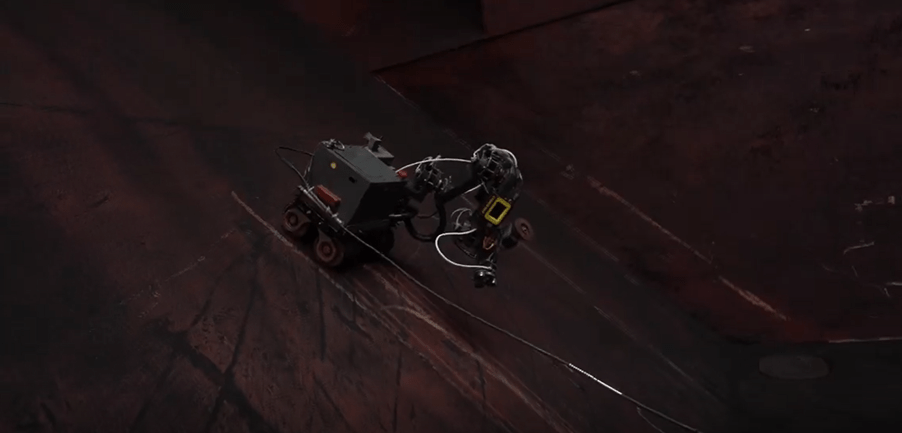
Image source : http://octobotics.tech/
The maritime and offshore industries grapple with the challenges of inspecting and maintaining valuable assets like ships, oil rigs, and subsea pipelines. Traditional methods often involve manual inspections, which are time-consuming, hazardous, and costly. With the advancement of AI and robotic technologies, the global market for robotic inspection services in these sectors is expanding rapidly, driven by the need for safer and more efficient solutions.
Innovative Solutions for Complex Challenges
Octobotics Tech, founded in 2020 and based in Noida, India, addresses these challenges with its AI-enabled robotic platforms tailored for the maritime and oil & gas industries. Its solutions, which enhance safety and efficiency by reducing the need for human intervention, include:
- Gauge Rover: A magnetic robot equipped with a 5-degree-of-freedom robotic arm for precise inspections.
- OCRV-UW: An underwater crawler designed for marine fouling removal and thickness gauging.
- Weld Sensei: An autonomous crawler utilizing Time of Flight Diffraction (TOFD) and Phased Array Ultrasonic Testing (PAUT) for weld inspections.
Octobotics Tech has made significant strides in deploying its technologies across various applications. Their robotic systems have been utilized for tasks such as cargo hold inspections on bulk carriers and pump barrel inspections in the oil & gas sector. Notable clients include L&T Heavy Engineering, Anglo-Eastern, and Chevron Saudi.

Image source : http://octobotics.tech/
Founders and Funding Milestones
The company was co-founded by Gulshan Kumar and Ishan Bhatnagar, both alumni of Jadavpur University with extensive maritime experience. Under their leadership, Octobotics Tech has secured $442K in funding over six rounds, with the latest seed round raising $71.9K in June 2024.
Impact on the Industry
Octobotics Tech’s advancements signify a transformative shift in how inspections and maintenance are conducted in the maritime and offshore sectors. By integrating AI and robotics, they not only enhance operational efficiency but also raise the bar for safety and consistency in high-risk environments.
As AI continues to evolve, we can expect a growing reliance on autonomous robotic systems across industries traditionally dependent on manual labor. From hull inspections to underwater welding, the fusion of intelligent software and precision hardware is reshaping what’s possible. Companies like Octobotics are not just solving today’s problems, they’re laying the groundwork for an era where robotics are the default solution for dangerous, repetitive, and high-stakes industrial tasks. The trajectory is clear: in the AI-powered future, smart machines will be doing the heavy lifting, literally and figuratively.
References:
- Kumar, G., & Bhatnagar, I. (2020). Octobotics Tech: Revolutionizing Maritime Inspection with Robotics. Retrieved from https://www.octobotics.tech/
- Tiwari, S., & Suresh, M. (2021). The Future of Maritime Inspections: Robotic Solutions. Journal of Maritime Technology and Engineering, 58(3), 234-242. https://doi.org/10.1016/j.jmar.2021.02.003
- Patel, R., & Mehta, K. (2022). Robotics in Marine Industry: A Case Study on Autonomous Inspection Technology. Marine Engineering Journal, 22(4), 148-155. https://doi.org/10.1016/j.meng.2022.04.001
- Singh, A., & Verma, R. (2023). Robotic Innovations in Maritime Maintenance and Inspection: Opportunities and Challenges. International Journal of Maritime Robotics, 5(1), 99-108. https://doi.org/10.1016/j.marrob.2023.01.005
- Ghosh, M. (2022). Non-Destructive Testing Technologies in Maritime Operations: The Role of Robotics. Maritime Technology Review, 31(2), 212-225. https://doi.org/10.1016/j.martech.2022.05.009
Contributor : Dyah Ayuning Tyas
Reviewer : Imam Buchari

 Scorpa's Tech @ Sea
Leave a comment