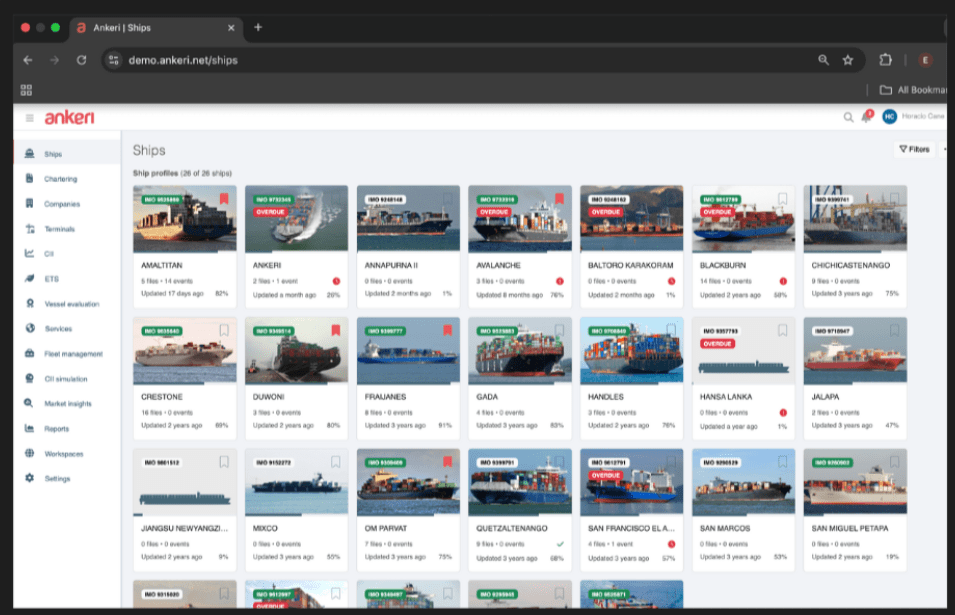
Source : www.ankeri.net/
Despite a decade of digitalization promises, much of the maritime industry still runs on spreadsheets, PDFs, and disjointed systems. As pressure mounts to cut emissions, optimize fleets, and comply with tightening regulations, data fragmentation is emerging as a silent threat; one that hinders not only compliance but also profitability.
Reykjavík-based Ankeri Solutions, founded in 2016 by former maritime professionals Kristinn Aspelund and Leifur Kristjánsson, is targeting that fragmentation head-on. Rather than offer yet another niche solution, Ankeri is building a unified platform that sits at the intersection of technical, commercial, and sustainability-driven decision-making. The result: better data, faster collaboration, and smarter ships.
The Fragmentation Problem
While the industry has made progress in voyage planning, performance monitoring, and emissions reporting, many solutions remain siloed, specialized, and built around specific stakeholder needs: owners, charterers, or technical managers. Data handoffs are often manual, inconsistently validated, and riddled with duplication or omission.
For companies trying to optimize fuel use, respond to charter party vetting, or evaluate vessel performance pre-fixture, this disjointed ecosystem is a liability. It’s not just a matter of convenience, it’s a direct drag on operational and environmental performance.
A Holistic Platform Built from the Ground Up
Ankeri’s platform differs from incumbent tools by offering a modular but deeply integrated environment. Instead of layering dashboards on top of legacy silos, Ankeri’s architecture is structured to eliminate redundancy and build a single source of operational truth. Users can connect commercial requirements, technical data, and environmental metrics in one environment, removing the blind spots that exist between, say, technical superintendents and chartering desks.
Key features include:
Owner-Charterer Collaboration Layer: Unlike solutions built solely for one side of the table, Ankeri’s platform supports secure bilateral data exchange, letting charterers vet vessels using live technical data while respecting owner-side confidentiality boundaries.
Living Vessel Profiles: Instead of static fleet lists, Ankeri offers dynamic vessel records that evolve as technical and performance data flows in, giving users a realistic picture of capabilities and constraints.
Workflow Customization Without Fragmentation: Companies can roll out modules for specific use cases (e.g., emissions benchmarking, pre-fixture vetting) while maintaining a shared data backbone, avoiding the migration traps of conventional plug-ins or bolt-ons.
Commercial Traction with Tier-One Clients
Ankeri’s value proposition has found validation with top-tier shipping names. Hapag-Lloyd, one of the world’s largest container liners, uses Ankeri to digitize and streamline its vessel pre-chartering questionnaire process, allowing compliance data to flow automatically between shipowners and internal vetting teams.
Other customers have leveraged Ankeri to improve energy efficiency decisions by integrating vessel-specific technical limitations with fuel consumption models and operational trade-offs. While exact figures are confidential, reported outcomes include material reductions in manual vetting workload, improved transparency in charter-party compliance, and data-driven progress toward fleet decarbonization goals.
Funding and Expansion
To accelerate growth, Ankeri closed a €2 million late-seed round in 2023 led by Frumtak Ventures, one of Iceland’s leading VC firms. The round followed earlier backing from the New Business Venture Fund, reflecting investor belief in the critical role of integrated data platforms in maritime sustainability.
The funding will support Ankeri’s expansion into broader European markets, deepen its predictive analytics capabilities, and scale deployments in tanker, dry bulk, and offshore segments where fuel and compliance margins are increasingly tight.
Navigating the Competitive Waters
While tools like Q88, NAPA, and AXSMarine serve key operational functions: vessel particulars, performance analytics, or fixture work flow most remain narrow in scope or designed around legacy paradigms. Integrations tend to be API bolt-ons rather than deeply co-engineered data ecosystems. Ankeri’s advantage lies in its cross-functional design, enabling stakeholders across departments and counterparties to collaborate meaningfully around current, structured, and verifiable data.
It’s a distinction that may prove critical as the industry faces mounting demands for carbon transparency, CII compliance, and more nuanced ESG reporting.
The Broader Signal
For maritime veterans watching the digital wave with a degree of scepticism, Ankeri may represent a rare case where software is actually keeping pace with operational complexity. It’s not a tool built for IT departments, it’s built for chartering leads, technical managers, compliance teams, and sustainability officers to align their decisions around the same data.
If maritime shipping is to digitalize and decarbonize without sacrificing margins, unifying its data core may be the biggest lever left. Ankeri isn’t just offering better dashboards to see critical core data, it’s aiming to restructure how that core works.
References
- Ankeri. (n.d.). About Us. Retrieved from https://www.ankeri.net/about-us?utm_
- PitchBook. (2025). Ankeri Company Profile: Valuation, Funding & Investors. Retrieved from https://pitchbook.com/profiles/company/178189-66?utm_
- TechCrunch. (2021). Shipping platform Ankeri, which also calculates carbon emissions, closes €2M round. Retrieved from https://techcrunch.com/2021/10/19/shipping-platform-ankeri-which-also-calculates-carbon-emissions-closes-e2m-round/?utm_source=chatgpt.com&guccounter=1&guce_referrer=aHR0cHM6Ly9jaGF0Z3B0LmNvbS8&guce_referrer_sig=AQAAAGGKn_FYPWq90CCRUCz9LMJPn8VzY0QRRYyt8WchsfoIs0bR_knwt3gKWp-2eXEEU8tP_obsuRTLrVythtq0R2Pynlzxj_7_8NSJhJtUC5zo1V-pGiVu-cgxS1bNBR881eL_nKWTKmw4-iP_t5yajIdEDAFzhFkzoqIb6t_6pgc6
- Ship Technology. (2025). Ship Technology Excellence Awards 2025: Ankeri Solutions. Retrieved from https://www.ship-technology.com/excellence-awards/featured-company/2025-ankeri-solutions/?utm_
Contributor : Ariana Tri Asti
Reviewer : Imam Buchari, David Ratner

 Scorpa's Tech @ Sea
Leave a comment