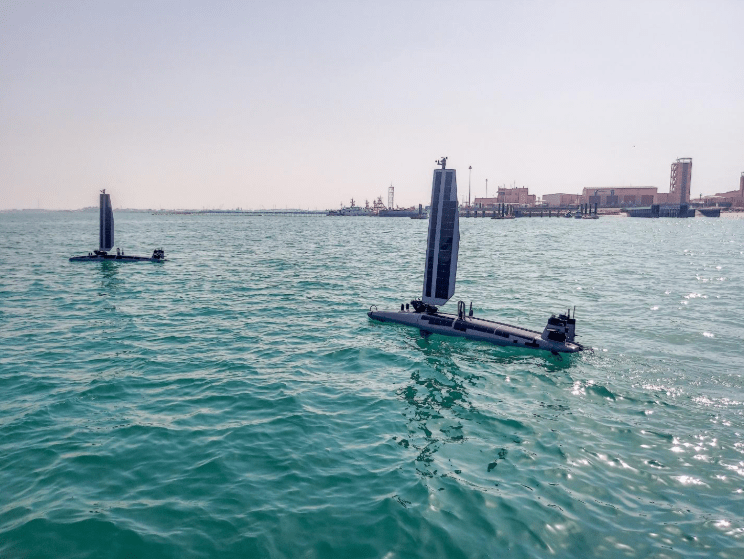
Maritime industries from research to defense face persistent challenges: high operational costs, limited vessel endurance, environmental impact, and gaps in data continuity. Crewed ships and conventional autonomous systems often rely on fuel and require frequent recovery.
Enter Ocean Aero, the start-up that developed Triton to address these issue. Triton is an energy-harvesting, hybrid Autonomous Underwater and Surface Vehicle (AUSV) capable of both sailing on the surface and gliding underwater. This dual-mode capability brings endurance, stealth, and operational efficiency to missions like ocean surveillance, scientific monitoring, offshore energy, and maritime defense.
Founded in 2010 in San Diego, Ocean Aero is led by Kevin Decker, its current CEO. Under their leadership, the company has grown from garage-scale prototypes to a 63,000 ft² manufacturing facility in Gulfport, Mississippi, with capacity to produce up to 150 Tritons per year.
Ocean Aero has secured multiple funding rounds and strategic investments & Partnership:
- 2014: Teledyne Technologies initial investment with strategic partnership. Teledyne Technologies, a leader in sensor systems and marine instrumentation, was an early strategic investor and continues to collaborate on integrating advanced payloads into the Triton platform
- 2015: Teledyne increased ownership to ~37%.
- Sept 2017: Lockheed Martin Ventures joined investing in Triton/Submaran. This investment allow the companies to continue to demonstrate their expertise in configuring teams of autonomous systems for complex missions. Lockheed Martin Ventures’ investment continues to increase the company’s maritime capabilities with a focus on intelligence, surveillance and reconnaissance (ISR).
- 2020: S2G Investments invested in Ocean Aero through the launch of its Oceans and Seafood Investment team. The total capital allocated to the Oceans and Seafood Fund was USD 100 million (EUR 84.7 million), distributed across 11 different portfolio companies. However, no specific information has been disclosed regarding the exact amount invested in Ocean Aero.
- 2023/24: Energy Innovation Capital co-led a multi-million-dollar Series B funding round to expand Triton’s use in offshore energy industries. In addition to these financial backers, Ocean Aero works directly with the U.S. Navy, NOAA, and academic institutions to provide long-duration ocean monitoring capabilities. These partnerships not only validate Triton’s technological promise but also secure its relevance across both commercial and government maritime sectors.
- Additional support via Mississippi state and local bodies for facility expansion.
Ocean Aero’s signature offering is Triton, an AUSV that supports:
- Environmental Monitoring: water chemistry, weather, seabed mapping
- Maritime Surveillance: persistent C4ISR in defense missions
- Offshore Energy: monitoring for oil rigs, wind farms, pipeline integrity
- Scientific Research: long-duration data collection with reduced manpower
Equipped with modular sensors and rechargeable via wind/solar, Triton frees vessels from fossil fuels, crew logistics, and tether dependencies.
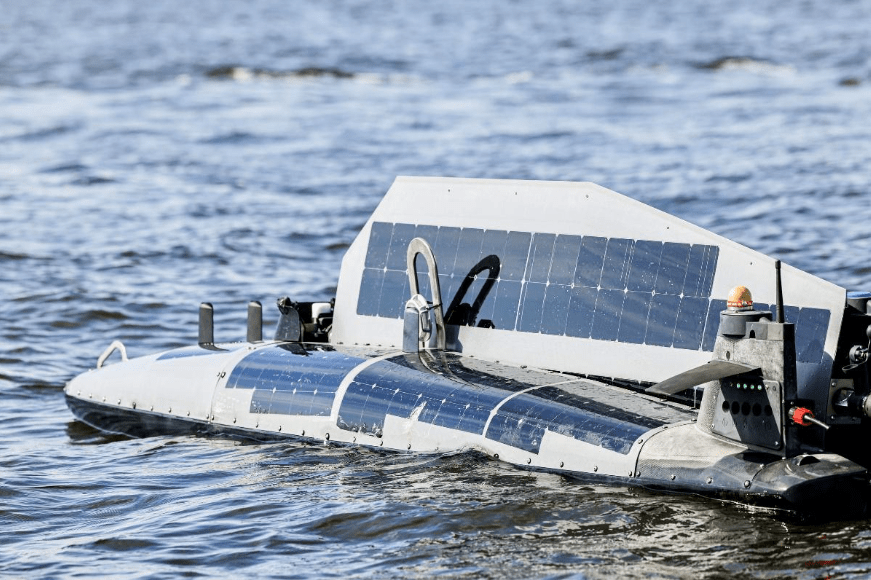
On the ocean surface, the Triton uses a vertical wing sail to harness wind energy for propulsion while simultaneously recharging its lithium-ion batteries via integrated solar panels. When required, the vessel can dive below the surface up to depths of approximately 200 meters by adjusting its buoyancy and engaging an electric thruster, allowing it to perform stealthy or data-specific underwater tasks.
Triton is equipped with autonomous navigation systems and mission-specific sensors that can monitor ocean chemistry, weather patterns, or perform acoustic surveillance. It surfaces periodically to transmit data via satellite, ensuring real-time communication with control centers. This operational flexibility allows it to serve in multi-domain applications, such as environmental monitoring, offshore infrastructure inspection, and naval surveillance reducing the reliance on crewed missions while increasing operational range and safety.
Ocean Aero’s Triton is redefining autonomous marine operations through its unmatched combination of sustainability, versatility, and operational endurance. By harnessing both wind and solar energy, the Triton eliminates reliance on fossil fuels, enabling missions that are not only cost-effective but also environmentally responsible. Its hybrid design seamlessly transitioning between surface sailing and underwater navigation empowers it to gather rich, multi-domain data across a wide range of maritime applications, from scientific research and environmental monitoring to offshore infrastructure inspection and defense surveillance. With modular sensor payloads, the Triton adapts to diverse mission requirements, offering a flexible platform that meets the needs of both government and commercial stakeholders.
While the Triton represents a significant advancement in maritime autonomy, certain operational constraints present opportunities for continued innovation. Its reliance on natural energy sources like wind and sunlight means performance can vary under prolonged low-wind or overcast conditions prompting development opportunities in hybrid energy storage and supplementary propulsion systems. With a cruising speed of 3-6 knots, the platform prioritizes endurance over velocity, opening space for optimization in speed-efficiency trade-offs for time-sensitive missions. The current 200-meter dive limit serves most coastal and mid-depth applications well, yet signals an opportunity for future models to explore greater subsea depths. As an emerging technology, Triton’s performance in highly dynamic or complex ocean environments is still being validated creating a pathway for enhanced AI-driven autonomy, adaptive mission planning, and broader integration with advanced sensor suites. These areas of growth reflect not limitations, but stepping stones in Ocean Aero’s continuous evolution to deliver even greater value across the maritime sector.
Ocean Aero’s Triton has proven its capabilities in a range of demanding real-world missions. During IMX 2022, a major multinational maritime exercise in the Middle East, Triton showcased its hybrid functionality by performing both above and below-surface operations for surveillance and reconnaissance tasks. The U.S. Navy and NOAA have deployed Triton for persistent environmental data gathering and underwater mapping missions, validating its endurance and data reliability in diverse marine environments.
Ocean Aero’s Triton stands as a pioneering AUSV offering an innovative blend of endurance, sustainability, and versatility. Optimal for maritime agencies and commercial operators, it delivers persistent ocean data collection while reducing costs and environmental impact. As partnerships and production scale expand, Triton is poised to reshape autonomous marine operations.
References
Ocean Aero. The Triton. Retrieved July 19, 2025, from https://www.oceanaero.com/the-triton
Marine Technology News. (2021, November 11). Ocean Aero Opens New Maritime Production Facility. https://www.marinetechnologynews.com/news/ocean-aero-opens-maritime-613411
Mississippi Development Authority. (2021, November 10). Ocean Aero opens new manufacturing facility at Port of Gulfport. https://mississippi.org/news/ocean-aero-opens-new-manufacturing-facility-at-port-of-gulfport/
Teledyne Technologies. (2015, January 12). Teledyne Increases Ownership in Ocean Aero. [Press Release]. Retrieved from a financial news archive.
Hydro International. (2017, October 10). Ocean Aero Receives Multi-Million Investment from Lockheed Martin Ventures and Energy Innovation Capital. https://www.hydro-international.com/content/news/ocean-aero-receives-multi-million-investment-from-lockheed-martin-ventures-and-energy-innovation-capital
S2G Ventures. (2020, July 29). S2G Ventures Launches Oceans and Seafood Fund to Catalyze a More Sustainable and Resilient Food System. [Press Release]. https://www.s2gventures.com/press-release/s2g-ventures-launches-oceans-and-seafood-fund-to-catalyze-a-more-sustainable-and-resilient-food-system
Integrated Ocean Observing System (IOOS). (n.d.). O-AERO: An Autonomous System for Air-Sea Observations. U.S. Marine Biodiversity Observation Network. Retrieved July 19, 2025, from https://marinebon.ioos.us/o-aero-an-autonomous-system-for-air-sea-observations/
Ocean Aero. (2023). Triton AUSV Datasheet. [PDF]. Retrieved July 19, 2025, from the Ocean Aero website.
Unmanned Systems Technology. (2022, March 14). Autonomous Surface & Underwater Vehicle Demonstrates Unique Capabilities. https://www.unmannedsystemstechnology.com/2022/03/autonomous-surface-underwater-vehicle-demonstrates-unique-capabilities/
Ocean Aero. (2021, May 26). Ocean Aero’s Triton Completes Autonomous 11-Day Voyage. [Press Release]. https://www.oceanaero.com/triton-completes-11-day-voyage
Contributor : Ariana Tri Asti
Reviewer : Imam Buchari, David Ratner

 Scorpa's Tech @ Sea
Leave a comment