
Image Credit: Triton Anchor
As floating wind, solar, and wave power technologies rapidly expand, developers face growing pain points around the scalability, cost, and environmental impact of traditional anchoring systems. Existing solutions such as gravity-based or drag embedment anchors are often heavy, expensive to install, environmentally disruptive, and reliant on large offshore vessels, which limits flexibility and inflates costs. These methods are particularly ill-suited for the projected surge in demand: by 2040, an estimated 40,000 anchors will be needed globally to support floating renewables, representing a potential £7.2 billion market. However, current anchoring technologies struggle to meet the scale, speed, and sustainability required for this growth, especially in deeper waters and sensitive marine environments.
Triton Anchor was founded in July 2022 in Chelmsford, Massachusetts, as a spin-off from Triton Systems Inc., focusing on scalable and sustainable anchoring solutions for floating offshore renewables. The company is led by CEO Nick Ritchie, with Zach Miller serving as CTO, and supported by industry experts David Model and Tyson Lawrence as managing members. Since its establishment, Triton Anchor has secured significant funding to accelerate its technology development and global deployment. In December 2022, it closed its initial seed round led by OS Impact Investments and MassCEC, further supported by grants from the U.S. Department of Energy (DOE), National Offshore Wind R&D Consortium (NOWRDC), and the U.S. Navy. On 2024, Triton Anchor completed an upgraded seed round, raising US $2.2 million. This round was co‑led by MWNW Consulting Group, with participation from OS Impact Investments, Katapult Deep Ocean Blue Fund, MassCEC, and the Triton Early Growth Fund . These investments highlight strong confidence in Triton Anchor’s potential to revolutionize offshore mooring systems for renewable energy.
Triton Anchor’s modular helical pile system supports all mooring configurations from catenary to tension-leg platforms across diverse seabeds. Benefits include:
- Reduced cost of installation and lower capital expenditures
- Ability to use smaller, quieter vessels increases port flexibility
- Reduced environmental footprints and seabed disturbance
- Near-site manufacturing capabilities enhance local economies.
Triton Anchor’s lightweight helical pile system reduces installation costs by allowing the use of smaller, more accessible vessels, while its silent, low-impact deployment minimizes seabed disturbance and protects marine ecosystems. Additionally, the modular design supports rapid, large-scale fabrication and is adaptable to various seabed types and mooring configurations, making it highly versatile for floating wind, solar, and wave platforms.
While Triton Anchor’s innovation delivers strong early benefits, there remain several opportunities for refinement. As a relatively new entrant, its helical pile technology still requires broader large-scale validation and long-term performance data to gain full regulatory acceptance, especially from global classification societies. Investing in more extensive third-party testing, pilot deployments, and data transparency could accelerate trust and market adoption. The system also demands a degree of specialized training and operational familiarity, presenting a short-term learning curve for port operators and installation crews. Addressing this by developing user-friendly interfaces, training programs, or even semi-autonomous deployment systems could reduce barriers. Lastly, in rocky or ultra-dense seabeds, the effectiveness of helical piles may be limited. Future R&D focused on hybrid or adaptive anchoring solutions could unlock deployments in these challenging environments, increasing the technology’s versatility and global applicability.
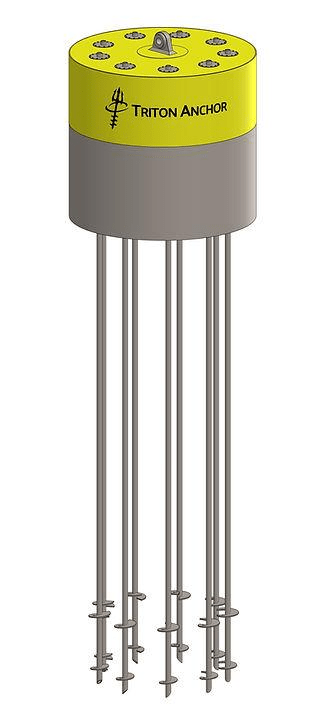
Image Credit: Triton Anchor
A detailed study conducted for the National Offshore Wind Research and Development Consortium (NOWRDC) evaluated Triton Anchor’s multi-pile configurations under realistic offshore wind load scenarios considering wave height, current, and wind forces at sites like Nantucket and Virginia Beach. The study found that by using multiline clusters, Triton Anchor could distribute horizontal loads more evenly, resulting in fewer anchors per field and lower per-anchor costs, particularly in shallower waters. In a Phase IIB project funded by the DOE and documented by the U.S. science portal PAMs, the company’s Helical Anchor Group Installation System (HAGIS) was shown to reduce anchor fabrication costs by 25–50% and installation costs by 10–30%, improving the levelized cost of energy (LCOE) for floating offshore wind in both the Northeast and West Coast U.S.
Through early validation studies and collaborations with both research organizations and industry leaders, Triton Anchor is proving its value proposition and securing a foothold in the global floating renewables sector.
References
Katapult VC. (2023). Cohort 2023: Triton Anchor. Retrieved from https://katapult.vc/ocean/cohort-2023-triton-anchor/
Marine Technology News. (2025, June 30). Triton Anchor gets patents for floating renewables anchoring tech. Retrieved from https://www.marinetechnologynews.com/news/triton-anchor-patents-floating-650514
National Offshore Wind Research and Development Consortium. (2024). Helical anchor group installation system final report. Retrieved from https://nationaloffshorewind.org/wp-content/uploads/154632-Final-Report.pdf
OEDigital. (2025, June 30). Triton Anchor gets patents for floating renewables anchoring tech. Retrieved from https://www.oedigital.com/news/527450-triton-anchor-gets-patents-for-floating-renewables-anchoring-tech
PAMS Public Science. (n.d.). Helical anchor group installation system (HAGIS). Retrieved from https://pamspublic.science.energy.gov/WebPAMSExternal/Interface/Common/ViewPublicAbstract.aspx?PRoleId=10&rtc=24&rv=bfa28941-3ecb-4d25-89ca-bbb1cf69fe76
PR Newswire. (2024, December 16). Triton Anchor completes seed financing, secures $3.5 million in new grant funding, and establishes a new European subsidiary. Retrieved from https://www.prnewswire.com/news-releases/triton-anchor-completes-seed-financing-secures-3-5-million-in-new-grant-funding-and-establishes-a-new-european-subsidiary-to-accelerate-european-expansion-and-offshore-wind-innovation-302332308.html
Renewables Now. (2024, December 18). Offshore anchoring firm Triton Anchor raises funds, enters Europe. Retrieved from https://renewablesnow.com/news/offshore-anchoring-firm-triton-anchor-raises-funds-enters-europe-1268281/
Triton Anchor. (2025, June). U.S. and Japan patents secured. Retrieved from https://www.tritonanchor.com/usandjapanpatentssecured
Triton Anchor. (2024, December 16). News & Events. Retrieved from https://tritonanchor.com/news-events/
Triton Anchor. (n.d.). Team. Retrieved from https://tritonanchor.com/team/


 Scorpa's Tech @ Sea
Leave a comment