
Source : https://www.marineinsight.com/
Customers in urban and maritime transportation face multiple challenges with existing ferry and waterborne transport systems. Traditional ferries often rely on fossil fuels, leading to high emissions and environmental impact. Manual operations require onboard crews, increasing operational costs and limiting scalability. Additionally, conventional ferries can be slow and inflexible, contributing to urban congestion and inefficiency in short-distance water transport. Safety concerns and regulatory hurdles around autonomous navigation also present barriers to adopting new technologies. Furthermore, retrofitting existing fleets with advanced autonomous and electric propulsion systems can be complex and costly, limiting widespread adoption. These pain points hinder cities and private operators from deploying greener, more efficient, and cost-effective maritime transport solutions that meet modern sustainability and urban mobility goals.
To overcome these challenges, Zeabuz offers an innovative solution that redefines urban water transport through autonomous electric ferries. Founded by Oyvind Smogeli from Norges teknisk-naturvitenskapelige universitet (NTNU) & Henrik Stray, Zeabuz is pioneering the use of autonomous electric ferries to transform short-distance waterborne transport into a safe, zero-emission, and highly efficient alternative. Headquartered in Trondheim, Norway, Zeabuz has quickly established itself as a frontrunner in maritime autonomy, with a focus on what it calls “Autonomy-as-a-Service.”
Zeabuz was born from years of research conducted by NTNU’s Centre for Autonomous Marine Operations and Systems (AMOS), where prototypes like MilliAmpere and MilliAmpere 2 were tested in the Trondheim canal. These early versions served as living laboratories, giving researchers real-time insights and helping develop advanced sensor fusion and navigation technologies. The company was co-founded by Erik Dyrkoren, a serial tech entrepreneur and former CEO of the Norwegian university commercialization company. He is joined by renowned researchers and engineers including Asgeir J. Sørensen, Tor Arne Johansen, and Egil Eide, who collectively shaped the technical backbone of Zeabuz’s autonomous navigation systems.
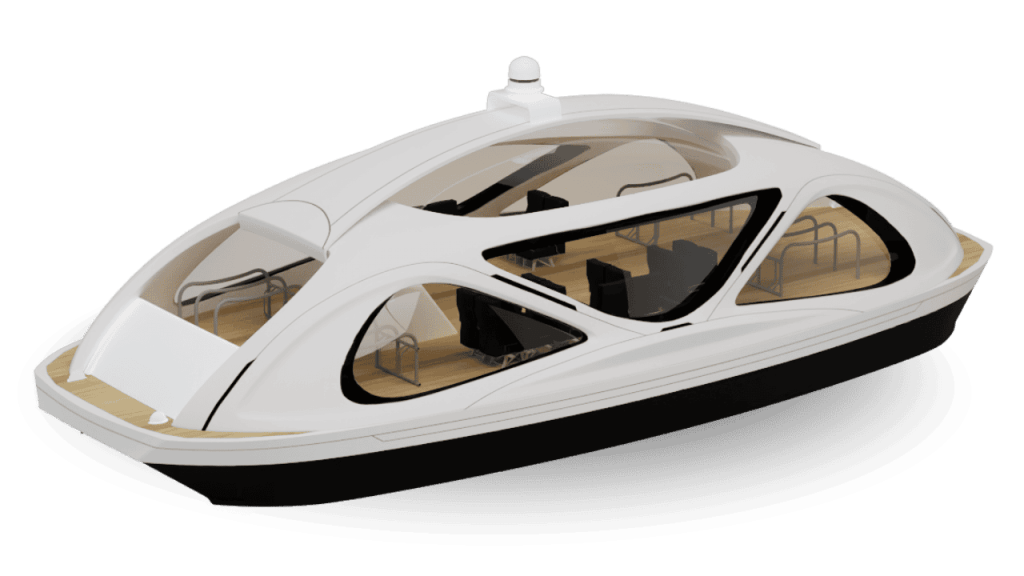
source : https://www.zeabuz.com/segments-ferries/
At the core of Zeabuz’s offering is its autonomous ferry platform, which incorporates a sophisticated combination of AI-driven navigation, sensor fusion, and remote supervision systems. The ferry operates at Autonomy Level 4, meaning it can operate without human intervention but with remote operator oversight if needed. Its flagship vessel, MF Estelle, currently operates in Stockholm, Sweden, as part of the Zeam ferry service. This ferry is a 12-meter, electric-powered catamaran that carries up to 24 passengers. Equipped with 11 marine radars, dual LiDAR sensors, 4 high-resolution cameras, AIS, GPS, and ultrasonic detectors, MF Estelle collects and processes environmental data in real time to navigate safely through urban waterways. The ferry is charged using both shore power and solar panels installed on deck, making the system truly sustainable from end to end.
The company’s business model is based on “Autonomy-as-a-Service”, which allows operators such as city governments or private ferry companies to integrate Zeabuz’s navigation and control systems into new or retrofitted electric boats. This modular approach lowers the entry barrier for adopting maritime autonomy while maintaining high safety and regulatory standards. Zeabuz also provides digital twins for simulation and training, along with dashboards for remote monitoring and diagnostics. Importantly, all autonomous operations are supervised by trained remote operators who can intervene if necessary, adding an extra layer of safety to the service.
Zeabuz’s innovation has attracted attention and funding from both public and private sectors. The company raised approximately €1.8 million (USD ~$1.9M) in seed funding, led by Statkraft Ventures (Norway/Germany), Yinson Green Technologies (Malaysia), and EIT Urban Mobility, an EU initiative to accelerate sustainable transport. Other strategic investors include Innovation Norway, Katapult Ocean, and Torghatten AS, a major Norwegian ferry operator. This diverse investor base demonstrates a strong belief in Zeabuz’s mission to build the future of urban water transport.
A shining example of Zeabuz’s impact is its partnership with Torghatten to launch Zeam, the commercial autonomous ferry service in Stockholm mentioned above. Launched in June 2023, the MF Estelle autonomously ferries passengers across a 700-meter stretch of water between Kungsholmen and Södermalm. With a crossing time of just six minutes versus 20 minutes by road. This ferry proves the efficiency of autonomous systems in reducing urban congestion. The ferry operates 15 hours a day at 15-minute intervals and has become a landmark in smart mobility and public transport innovation. The success in Sweden has encouraged further expansion, including a 50-passenger autonomous ferry project in Haugesund, Norway, planned for 2025, and a partnership with Future Marine in Canada to develop a 12-passenger electric ferry suitable for North American waterways.
Zeabuz represents more than just a ferry company, it symbolizes a new paradigm in city planning, sustainability, and innovation. By eliminating the need for onboard crew and relying on electric propulsion, cities can deploy cost-effective, safe, and emission-free mobility solutions on underutilized waterways. The company’s technology is aligned with global goals for carbon neutrality, urban resilience, and digital transformation. As demand for autonomous and electric public transport grows, Zeabuz is positioned as a key enabler in the transition toward smart, sustainable coastal and river-based transport systems.
References
- Zeabuz Official Website. (2024). https://www.zeabuz.com
- Lunden, I. (2023). Zeabuz launches world’s first driverless electric ferry in Stockholm. Vision Systems Design. https://www.vision-systems.com
- Dyrkoren, E. (2023). Zeabuz on Autonomy-as-a-Service and Future Mobility. Scandinavian Mind. https://scandinavianmind.com
- Maritime Executive. (2024). Haugesund chooses Zeabuz for new autonomous ferry. https://www.maritime-executive.com
- Arctic Startup. (2023). Zeabuz raises €1.8M seed round for scaling autonomous ferry operations. https://arcticstartup.com
- PitchBook. (2023). Zeabuz Funding Profile. https://pitchbook.com
- Offshore Energy Biz. (2024). Zeabuz partners with Future Marine for autonomous ferries in Canada. https://www.offshore-energy.biz
- Statkraft Ventures. (2023). Investment in Zeabuz. https://www.statkraftventures.com
- EIT Urban Mobility. (2023). Impact Stories: Zeabuz’s Zero-Emission Ferry. https://www.eiturbanmobility.eu
Contributor : Dyah Ayuning Tyas
Reviewer : Imam Buchari, David Ratner

 Scorpa's Tech @ Sea
Leave a comment