
Image Credit: xocean.com
Gathering high‑resolution seabed, sub-surface, and environmental data is essential for safe navigation, infrastructure planning, and ecosystem monitoring. However, these missions often involve long deployments in remote, harsh environments, posing safety risks for crews and high emissions.
XOcean addresses this challenge with uncrewed surface vessels (USVs) that autonomously perform extensive bathymetric and geophysical surveys far offshore while operators remain safely onshore. XOCEAN was founded in 2017 in Ireland by James Ives, previously CEO of tidal turbine developer OpenHydro, which sold to DCNS in 2013. Ives leveraged his experience to build a marine robotics company focused on sustainable ocean data collection
Since its founding, XOCEAN has successfully attracted significant investment to scale its autonomous ocean data services. The company secured €30 million in a Series B round in June 2024, led by VentureWave Capital and supported by Endeavor Catalyst, Enterprise Ireland, and a €20 million debt facility from the European Investment Bank (EIB). In early 2025, XOCEAN raised an additional €115 million (~$119 million) in a growth-stage round led by S2G Ventures, Climate Investment, Morgan Stanley’s 1GT fund, and CC Industries, structured by VentureWave. Prior to these rounds, XOCEAN also closed an early-stage pre-Series B funding of €6.5 million, which included notable investors such as U2’s The Edge. Collectively, these funding rounds bring XOCEAN’s total raised capital to over €150 million, highlighting strong investor confidence in its scalable, climate-aligned marine technology.
XOCEAN’s technology centers around its XO-450 class Uncrewed Surface Vessels (USVs), which are 4.5-meter autonomous catamarans equipped with electric propulsion, solar panels, and a backup diesel micro-generator for extended missions. These vessels operate remotely via satellite communications (such as Starlink and Iridium), allowing pilots and data analysts to control and monitor operations from shore-based centers. In maritime applications, the USVs are deployed to conduct seabed mapping, pipeline inspections, environmental monitoring, and wind farm surveys. Collecting data through multibeam echo sounders (MBES), side-scan sonar, sub-bottom profilers, and water quality sensors. Missions are pre-programmed with precise waypoints, and the vessels operate continuously for up to 18 days at sea, navigating autonomously and transmitting real-time data to cloud platforms. This system enables high-resolution, scalable, and low-carbon data acquisition in remote offshore environments. Offering a safe, efficient alternative to traditional crewed survey ships.
Clients include BP, Shell, Ørsted, SSE Renewables, and the UK Hydrographic Office (UKHO). The data supports safer maritime navigation, site selection, and ongoing infrastructure integrity, while cutting operational costs and emissions. Since inception XOcean has operated missions globally across 22 jurisdictions, supporting development of over 43 GW of offshore wind capacity and collecting over 4 million GB of data.
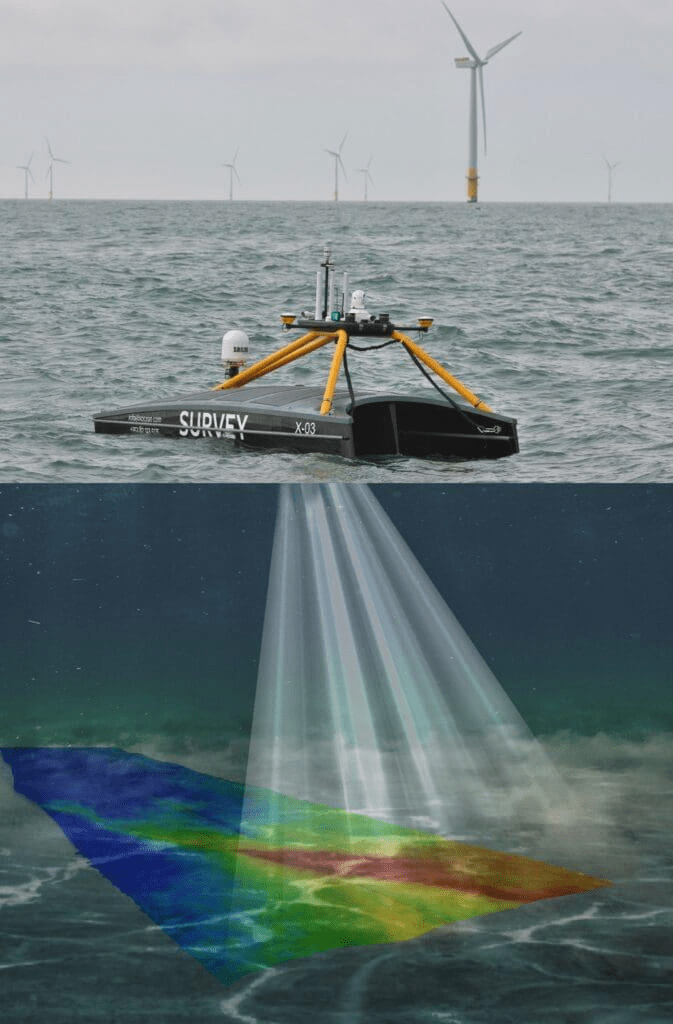
Image Credit: xocean.com
XOCEAN’s USVs deliver ultra-low-carbon, cost-effective ocean data services with minimal environmental footprint (~0.1% of traditional emissions), improved safety (no crew offshore), and flexibility for long-duration, remote deployments. The pay-for-data business model avoids vessel-day pricing, enhances accessibility, and supports scalable global operation. Teams remain onshore, reducing logistical complexity and crew risk. The vessels operate reliably in sea states up to 5–6, collecting continuous high-quality data across multiple missions simultaneously.
While XOCEAN’s uncrewed surface vessels (USVs) have demonstrated clear advantages in safety, cost, and sustainability, several challenges exist to further enhance their offering. The relatively low transit speeds of the XO‑450 series (around 3–4 knots) may limit responsiveness in time-sensitive missions, suggesting potential for investment in faster propulsion systems or mission-specific vessel variants. Similarly, the current payload and energy capacity restrict the use of more advanced or heavier sensor packages, which could be addressed through next-generation power storage or modular USV designs. Operating limits in sea states above 5-6 also create constraints in harsher marine environments, highlighting the opportunity to improve hull design and weather-handling capabilities. On the regulatory front, the evolving legal landscape around uncrewed vessel operations especially in congested shipping lanes calls for proactive engagement with maritime authorities to standardize frameworks and build operational trust.
That said, XOCEAN’s uncrewed vessels have been deployed in a wide range of use and study cases, showcasing their versatility across offshore industries. In collaboration with the UK Hydrographic Office, XOCEAN completed a major uncrewed seabed mapping mission covering over 2,200 square kilometers near the Isles of Scilly, delivering high-quality bathymetric data in challenging winter conditions. For Ørsted’s Hornsea One offshore wind farm, the XO-450 USV successfully monitored scour around turbine foundations and cable burial depths, completing a 229-nautical-mile mission with minimal carbon emissions and zero downtime. Similarly, pipeline inspections for Equinor in the North Sea demonstrated the USV’s capability to collect precise subsea data without deploying crewed vessels. Additional missions for Vattenfall across multiple offshore wind sites further validated XOCEAN’s technology as a scalable, low-emission solution for environmental surveys, infrastructure monitoring, and data-driven maritime planning.
XOCEAN has built a strong network of key partnerships and high-profile clients across the maritime and energy sectors, solidifying its position as a trusted provider of uncrewed ocean data services. These collaborations are supported by technology partnerships with satellite communication providers like Starlink and Iridium for over-the-horizon operations. Furthermore, XOCEAN’s growth is backed by strategic investors such as VentureWave Capital, S2G Ventures, and the European Investment Bank, who recognize the company’s ability to transform ocean intelligence through sustainable and scalable technology.
XOCEAN represents a groundbreaking advancement in maritime data acquisition, addressing critical industry challenges related to cost, safety, and environmental impact. By deploying autonomous, uncrewed surface vessels (USVs) powered by clean energy and operated remotely via satellite, XOCEAN provides high-resolution seabed and environmental data more efficiently and sustainably than traditional crewed methods. With robust partnerships, proven use cases, and an innovative “data-as-a-service” model, XOCEAN is setting new standards for how maritime industries explore, monitor, and understand our oceans, ultimately ushering in a safer, cleaner, and more data-driven future for the blue economy.
References
Davenport, T. (2023). Offshore wind farm surveys using USVs (white paper). XOCEAN. Retrieved from https://r3vox.com/wp-content/uploads/2023/03/XOCEAN-WHITE-PAPER-OFFSHORE-WIND-SURVEYS-FINAL-APPROVED-Word.pdf
Delaney, F. (2024, March 18). Autonomous bathymetric survey in the UK Atlantic. Hydro International. Retrieved from https://www.hydro-international.com/content/article/autonomous-bathymetric-survey-in-the-uk-atlantic
Edwards, D. (2025, January 15). XOCEAN secures €115 million investment to accelerate growth of its ocean data services platform. Robotics and Automation News. Retrieved from https://roboticsandautomationnews.com/2025/01/15/xocean-secures-e115-million-investment-to-accelerate-growth-of-its-ocean-data-services-platform/88585
IHO. (2022). Autonomous survey in northern environments. International Hydrographic Review. Retrieved from https://ihr.iho.int/articles/autonomous-survey-in-northern-environments
JPT Staff. (2023, January 11). Uncrewed vessels survey the seafloor. Journal of Petroleum Technology. Retrieved from https://jpt.spe.org/uncrewed-vessels-survey-the-seafloor
Sawers, P. (2025, January 9). XOCEAN raises €115 million to capture ocean data with uncrewed surface vessels. TechCrunch. Retrieved from https://techcrunch.com/2025/01/09/xocean-raises-119m-to-capture-ocean-data-with-uncrewed-surface-vessels
UKHO Digital. (2024, January 15). Plotting a safe course for autonomous vessels. UK Hydrographic Office Blog. Retrieved from https://ukhodigital.blog.gov.uk/2024/01/15/plotting-a-safe-course-for-autonomous-vessels
Unmanned Systems Technology. (2022, February 4). First uncrewed vessel survey in Irish waters. Retrieved from https://www.unmannedsystemstechnology.com/2022/02/first-uncrewed-vessel-survey-in-irish-waters
VentureWave Capital. (2024). XOCEAN case study. Retrieved from https://venturewave.com/xocean-case-study
XOCEAN. (2024, June 11). XOCEAN secures €30m to transform ocean data. Retrieved from https://xocean.com/xocean-secures-e30m-to-transform-ocean-data
 Scorpa's Tech @ Sea
Leave a comment