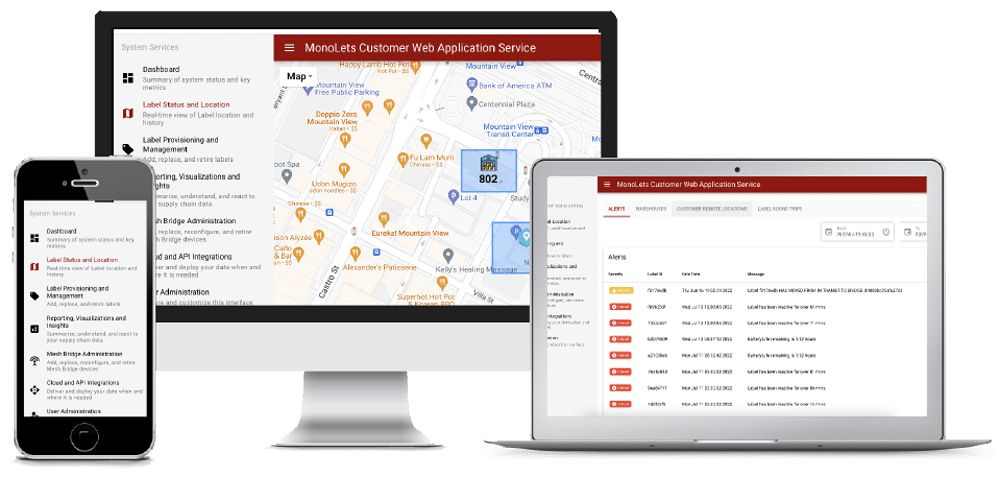
Image Credit: monolets.com
Maritime transport, especially vehicle carriers, faces a persistent challenge: detecting fires early enough to prevent catastrophic damage. Traditional fire detection systems, relying on smoke or heat sensors, often trigger too late typically at temperatures around 84 °C and cover vast areas per sensor, yielding imprecise localization. Compounding the issue, extractor fans can disperse smoke away from detectors, and crew inspections are slow and obstructed by tightly packed cargo. Given that fires can spread in as little as five to ten minutes, there’s a critical need for early, precise, and low-cost detection solutions in the maritime setting.
MonoLets was founded in 2016 out of research at UC Berkeley, bringing together experts in wireless sensor networks and low-power IoT systems. The leadership team is spearheaded by Dr. Osama Khan, who serves as Chief Executive Officer, alongside co-inventors and technical leaders including David Burnett, Kristofer Pister, and Bradley Wheeler. Their combined expertise spans academia and industry, with backgrounds in electrical engineering, wireless communications, and large-scale distributed systems. This multidisciplinary foundation has enabled MonoLets to translate cutting-edge research into a practical solution that addresses critical challenges in maritime fire detection and supply chain visibility.
MonoLets has attracted support from strategic investors and accelerators that focus on deep tech and connectivity innovation. The company joined Berkeley SkyDeck in 2016 as part of its early-stage development and later secured investments from hubraum, the Deutsche Telekom venture arm, with two separate funding rounds in 2020 and 2022 to scale its wireless sensor technology. While specific funding amounts have not been publicly disclosed, these investments highlight growing confidence in MonoLets’ potential to transform asset visibility and maritime safety through scalable, low-cost IoT solutions.
MonoLets delivers comprehensive, item-level real-time visibility into assets in transit. Its solution is grounded in patented, low-power wireless mesh technology developed at UC Berkeley. Using Bluetooth based shipping labels embedded with sensors, the system captures temperature, humidity, GPS, and 3D location data. These labels self-organize into a mesh network, enabling robust, real-time coverage across densely packed and RF-challenged maritime environments such as ship cargo decks. The core system operates continuously during voyages, transmitting condition and location data via API to enable early detection of pre-fire thermal changes.
As a full stack platform, MonoLets provides hardware, software, cloud backend, and APIs all accessible to clients for seamless integration. The wireless mesh network enables sensors to relay data every second, with extremely low power consumption capable of operating for up to five years on a small battery and costs estimated at around $1 USD per node, once production reaches scale. In maritime trials, such as the SafetyTech Accelerator pilot with Wallenius Wilhelmsen, approximately 40,000 sensors would be required to cover a large roll on/roll off vehicle deck, enabling early warnings and precise localization of thermal events.
Finally, the platform’s capabilities extend beyond fire detection to include condition monitoring (temperature, humidity), asset location, and inventory control, offering enhanced inventory accuracy, and monitoring of condition metrics that support logistics efficiency.
However, deployment density is high; one pilot determined node spacing must be around 2.5 m to maintain network reliability, up from ideal lab spacing of 1 m meaning a large number of devices needed for adequate coverage, increasing complexity. Initial pilot tests revealed network disconnections and reliability issues at wider node spacing, requiring fine-tuning of placement.
MonoLets has built strong partnerships and collaborations that accelerate its adoption in critical industries, particularly maritime. Through the SafetyTech Accelerator, the company collaborated with Wallenius Wilhelmsen, one of the world’s largest vehicle carriers, to pilot its fire detection and monitoring system at sea. In addition, MonoLets maintains ties with UC Berkeley’s SkyDeck accelerator, where its foundational research was incubated, and has secured strategic backing from hubraum, Deutsche Telekom’s venture hub, which also facilitated demonstrations in Europe with enterprise partners. These collaborations not only validate the technology in real-world environments but also provide MonoLets with access to industry networks and potential major clients across logistics, shipping, and telecommunications.
References
Hubraum. (n.d.). MonoLets – Top Tech Tales. Retrieved August 26, 2025, from https://www.hubraum.com/startups-and-partners/top-tech-tales/monolets
IPIRA UC Berkeley. (n.d.). MonoLets, Inc. Retrieved August 26, 2025, from https://ipira.berkeley.edu/monolets-inc
MonoLets. (n.d.). Company Overview. Retrieved August 26, 2025, from https://www.monolets.com/company
MonoLets. (n.d.). Solution. Retrieved August 26, 2025, from https://www.monolets.com/solution
Safetytech Accelerator. (2020, March 3). Startup deploys wireless sensors across ship’s cargo hold to predict fire. Retrieved August 26, 2025, from https://safetytechaccelerator.org/news/startup-deploys-wireless-sensors
Wallenius Wilhelmsen. (2019, December 12). Tech start-up tackles onboard fire risk. Retrieved August 26, 2025, from https://www.walleniuswilhelmsen.com/insights/tech-startup-fire-risk
CB Insights. (n.d.). MonoLets Company Profile. Retrieved August 26, 2025, from https://www.cbinsights.com/company/monolets-1
Preqin. (n.d.). MonoLets, Inc. Profile. Retrieved August 26, 2025, from https://www.preqin.com/data/profile/asset/monolets-inc-/455278


 Scorpa's Tech @ Sea
Leave a comment