
Image Credit: bluenav.com
Marine vessels powered by internal combustion engines (ICE), whether outboards or inboards, contribute significantly to greenhouse gas emissions, underwater noise pollution, and local environmental degradation (especially in ecologically sensitive or protected waters). Regulations are increasingly imposing restrictions in certain waterways and harbors regarding emissions, noise, and anchoring; plus, boaters increasingly demand better comfort (less noise, less odor), lower operating costs (fuel, maintenance), and environmental responsibility. At the same time, full electrification is not always feasible: battery energy density, range, weight, cost, and infrastructure limit how far electric-only propulsion can go, especially for medium-size boats or vessels needing higher speed or long range. Hence, a hybrid approach combining electric propulsion for low speed, “quiet” or sensitive situations (harbor, marine protected zones, manoeuvering, observation, etc.) with combustion engines for high speed legs is often seen as a practical transitional solution.
BlueNav addresses this gap by developing hybrid electric motorization, specifically modular add-on electric motors (the “BlueSpin” line) that can be retrofitted or integrated in new builds, allowing vessels to switch between electric and combustion propulsion depending on needs, without massive hull redesign or full replacement of existing systems. This technology is needed to enable gradual decarbonization of boating, meet regulatory and market pressure, and enhance onboard comfort/ecological impact.
BlueNav was co-founded in 2020 by Hervé Frouin, an engineer with extensive experience in marine technologies who also served as the company’s early CEO before focusing on product development as CTO, driving innovations such as retractable hybrid electric motors designed for harsh maritime environments. In January 2025, leadership transitioned to Xavier Lachérade, appointed as CEO to strengthen industrial scaling and international expansion; he brought expertise in project management, innovation strategy, and industrialization. Together, Frouin’s technical vision and Lachérade’s leadership form a complementary foundation for BlueNav’s mission to transform hybrid propulsion in the boating industry.
BlueNav’s funding journey reflects strong investor confidence in its hybrid-electric propulsion technology, beginning with a €1.3 million seed round in October 2022 led by SWEN Capital Partners’ Blue Ocean Fund, with participation from ARDEV and DeepIE Ventures, aimed at scaling industrial production and expanding into international markets. This injection of capital brought the company’s total equity base to around €2 million, supporting faster delivery times, broader commercial outreach, and further R&D for innovations like its biomimetic Whale Design turbines. While BlueNav has not yet announced a Series A round, the early backing from sustainability-focused investors underscores its alignment with the global push for greener maritime solutions and positions the company well for future large scale financing.
BlueNav’s product portfolio centers on its BlueSpin hybrid electric motor systems, available in outboard, inhull, and stationary configurations, all designed to retrofit existing boats or integrate into new builds with minimal structural changes. These retractable electric turbines allow vessels to operate silently and emission-free in sensitive zones or harbors, while switching back to combustion engines for longer voyages or higher speeds. For seafarers and companies, the technology delivers practical benefits: reduced fuel consumption, compliance with tightening environmental regulations, enhanced maneuverability through features like virtual anchoring and lateral docking, and improved comfort by eliminating noise, fumes, and vibration during low-speed operations. This makes BlueNav’s solutions not only eco-friendly but also cost-efficient and operationally versatile.
BlueNav’s technology works through its retractable BlueSpin electric motors, which can be seamlessly integrated into boats alongside traditional combustion engines to create a hybrid propulsion system. When vessels need quiet, clean, and emission free operation such as in harbors, protected marine zones, or while docking the electric turbines are deployed into the water, powered by onboard batteries and managed through an intuitive Human-Machine Interface (HMI). For higher speeds or longer distances, the turbines can be retracted to eliminate drag, allowing the main combustion engines to take over, ensuring efficiency and range. This hybrid flexibility is further enhanced by smart features like virtual anchoring, autopilot modes, and lateral docking assistance, giving operators precise control and reducing fuel usage, maintenance costs, and environmental impact while enabling compliance with stricter maritime regulations.
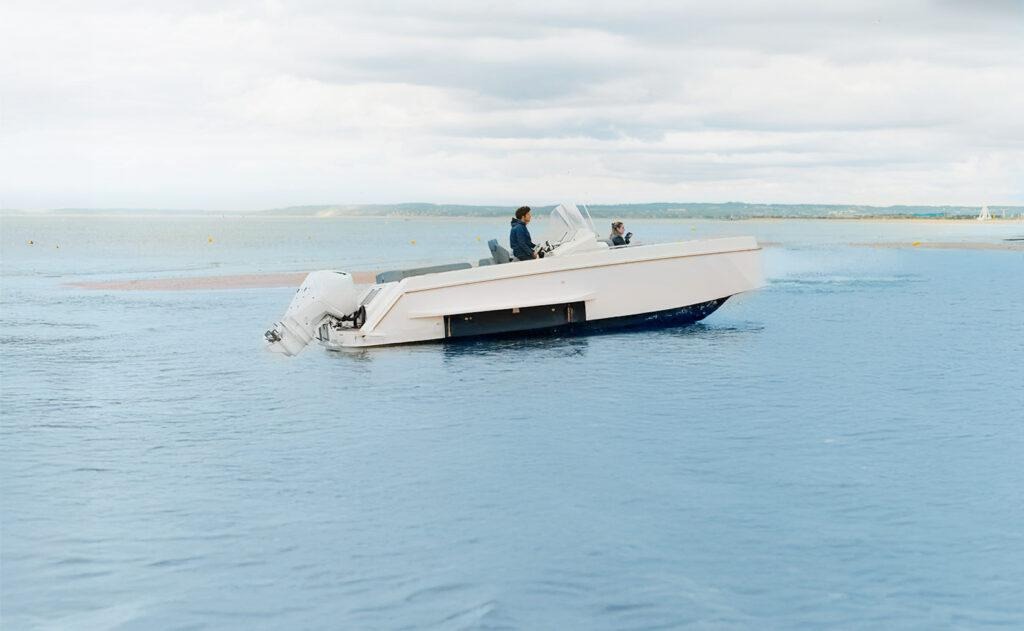
Image Credit: bluenav.com
Some specific examples or cases where BlueNav’s technology has been used or is proposed:
- Rock Emperor: A 12 m (≈ 39 ft) picnic-style vessel by Dubourdieu shipyard. It has two ICE outboards and two 15 kW BlueSpin retractable electric motors added under a transom extension. The ICE engines are used for high speed/transit; when approaching sensitive areas or docking, the BlueSpin units are deployed.
- Night Ocean: A vessel with twin big inboard ICE motors supplemented by BlueSpin electric motors. Used for silent, low-speed operation.
- Smaller vessels: The system also can fit on sailboats, monitoring/patrol, surveillance vessels, fishing boats, etc. The retractable minimal design helps where drag or hull shape matters.
BlueNav’s hybrid propulsion systems are especially valuable in scenarios where both environmental sensitivity and operational flexibility are essential. For example, eco-tourism operators can use the silent electric mode to approach marine wildlife without disturbance, while harbor authorities and leisure boaters benefit from emission-free maneuvering during docking or within marinas. In protected marine areas or inland waterways with strict environmental regulations, BlueNav’s technology enables vessels to operate legally and responsibly without sacrificing range or performance. Additionally, the retrofit capability makes it attractive for existing boat owners and commercial fleets who want to reduce fuel costs and meet sustainability goals without replacing their entire vessels. This adaptability across leisure, tourism, and professional maritime sectors demonstrates how BlueNav bridges today’s operational demands with the growing push for greener navigation.
On the client side, collaborations with shipyards such as Dubourdieu have brought hybrid-electric solutions into real-world applications, including the integration of BlueSpin motors on vessels like the Rock Emperor. The company has also gained visibility and trust through industry recognition, winning awards at Salon Nautic Paris and METSTRADE, which positioned it as a credible partner for future large-scale projects. While still growing, these partnerships and early client projects demonstrate strong momentum and signal BlueNav’s potential to attract bigger fleets and commercial operators in the near future.
BlueNav represents a promising hybrid-electric propulsion startup offering an intermediary solution on the way to fully electric boating. Its Whale Design innovation shows attention to hydrodynamic performanc while its modular, retractable units and clever software support, address many of the concerns preventing adoption of electric propulsion today: cost, range, retrofitability, and operational flexibility. However, challenges remain: batteries, chargers, durability in harsh marine environments, cost, adoption inertia. How well BlueNav scales, secures large clients (e.g. commercial or fleet operators), and continues lowering cost will ultimately determine its impact.
References
BlueNav. (2024, May 31). BlueNav Whale Design embodies the sophistication of nature’s influence. Retrieved from https://bluenav.com/en/bluenav-whale-design/
BlueNav. (2025, January 16). BlueNav appoints Xavier Lachérade as CEO. Retrieved from https://bluenav.com/en/bluenav-appoints-xavier-lacherade-as-ceo/
Plugboats. (2022, October 13). French electric/hybrid manufacturer BlueNav secures €1.3M funding. Retrieved from https://plugboats.com/french-electric-hybrid-motor-bluenav-1-3m-funding/
Pôle Smart Power. (2023). BlueNav: 1,3 Meuros to meet the demand for electric boats. Retrieved from https://www.polesmartpower.fr/en/bluenav-13meuros/
The Yacht Insider. (2024, November 7). BlueNav’s BlueSpin Motors Bring Simple Hybrid Power. Retrieved from https://www.theyachtinsider.com/post/forget-complex-installs-bluenav-s-bluespin-motors-bring-simple-hybrid-power
Yachting Magazine. (2022, September 7). BlueNav Bluespin Retractable Motors Have Hybrid Propulsion. Retrieved from https://www.yachtingmagazine.com/gear/bluenav-bluespin-hybrid-propulsion/
IBI News. (2024, January 26). How the humpback whale is helping BlueNav improve engine performance. Retrieved from https://www.ibinews.com/technology/how-the-humpback-whale-is-helping-bluenav-improve-engine-performance/47255.article


 Scorpa's Tech @ Sea
Leave a comment