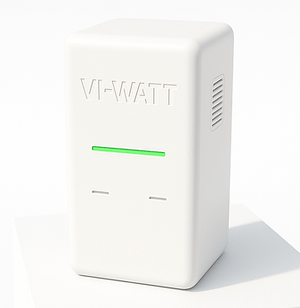
As the global shipping industry grapples with the International Maritime Organization’s (IMO) stringent new carbon intensity mandates, a Spanish green-tech startup is proposing an elegant, low-cost solution to a high-seas headache: transforming the humble water heater into a strategic energy asset.
VI-WATT, a Barcelona-based IoT specialist Founded by Sergio Fomin, is pivoting its core technology toward the maritime sector, targeting the “hotel load”; the significant energy consumption required for crew and passenger hot water. While the industry often focuses on multi-million dollar engine overhauls or alternative fuels, VI-WATT argues that optimizing existing auxiliary assets through software-defined hardware can offer immediate, high-impact gains in vessel efficiency.
The Maritime Efficiency Gap
Modern vessels operate on razor-thin energy margins. Traditionally, electric water heaters on ships are “dumb” assets, firing at 100% capacity whenever a thermostat drops. This often forces auxiliary engines to run at higher loads during peak demand, increasing fuel consumption and carbon output.
VI-WATT’s primary offering is a five-minute IoT retrofit controller that introduces”Phase Angle Control modulation” or “Power modulation.”. Unlike traditional on/off relays, the system modulates power consumption from 0–100% in real-time, allowing ship operators to store heat during periods of low electrical demand or when shaft generators are at their most efficient. This “peak shaving” capability prevents generator spikes and can reduce water heating energy costs by up to 50% by aligning consumption with optimal engine performance windows.
The primary advantage of the VI-WATT solution is its extreme cost-effectiveness; as a retrofit-first technology, it eliminates the need for ship owners to replace perfectly functional heaters with expensive new “smart” models. It effectively upgrades an “F-rated” legacy appliance to “A+++” performance levels in under five minutes. Furthermore, the device provides high-resolution data that is increasingly critical for ESG reporting and Carbon Intensity Indicator (CII) audits. For port authorities and utilities, the technology offers a “Virtual Power Plant” (VPP) capability, where docked vessels can temporarily “throttle” their load to help stabilize local municipal grids.
Funding and Strategic Roadmap
VI-WATT is currently in its Pre-Seed stage, targeting a €0.5M round. The company is focusing on B2B strategic partnerships and is actively seeking pilot projects with TSO/DSO aggregators, operators, and shipbuilding companies. ensures that the technology is integrated directly into industrial maritime infrastructure.
Final Thought
The maritime industry’s path to “Net Zero” is often framed as a choice between expensive future fuels and radical new hull designs. However, VI-WATT’s entry into the space suggests that the most immediate path to decarbonization may be through digital intelligence rather than physical replacement. By weaponizing existing infrastructure with IoT modulation, ship owners can find the marginal gains necessary to survive the current regulatory climate. In a sector where every gram of fuel counts, the ability to treat a water heater as a strategic energy buffer isn’t just a convenience it’s a competitive necessity for the modern fleet.
References
- European Commission. (2024). Electricity Market Design Regulation (2024/1747/EU): Strengthening grid flexibility. Retrieved from https://energy.ec.europa.eu/
- VI-WATT. (2025). About us: Founders & Innovators of Smart Energy. Retrieved from https://www.vi-watt.eu/about-us
- Zhu, X., & Wang, L. (2023). IoT-based analysis for smart energy management: Power disaggregation and patterns. arXiv preprint arXiv:2311.18643.
- Tech.eu. (2026). The companies dominating European energy-tech funding in 2025. Retrieved from https://tech.eu/2026/01/15/

 Scorpa's Tech @ Sea
Leave a comment