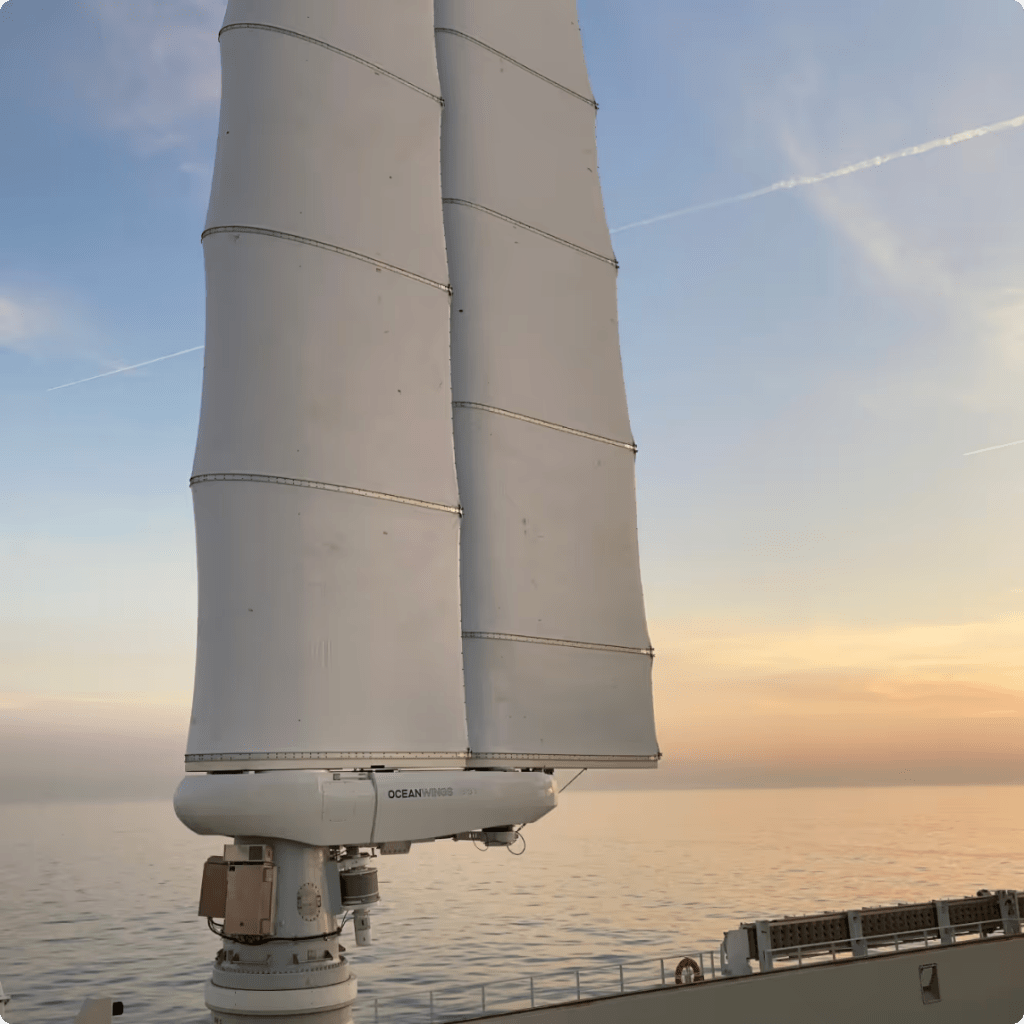
Image credit: oceanwings.com
The shipping industry carries about 90% of global trade by volume and is responsible for a substantial share of global CO₂ emissions. Without intervention, shipping could account for up to ~17% of human CO₂ emissions by 2050. While the IMO’s green framework may have been delayed, regulations (such as the Energy Efficiency Design Index (EEDI), CII, etc.) are tightening, pushing ship owners to reduce fuel consumption and emissions. Traditional methods (fossil fuels) are costly both economically (fuel costs) and environmentally (emissions, pollution). Alternative fuels (LNG, biofuels, hydrogen) are still challenging to scale or have trade-offs.
Wind has been used historically (sails), but modern wind‐assisted propulsion was under-utilized due to the complexity of control, structural challenges, and integration issues. The re-emergence of high performance wingsail systems with automation, computer control, and more efficient aerodynamics makes wind propulsion attractive once again.
OceanWings aims to harness wind to reduce fuel consumption, lower emissions, and help ship operators meet regulatory and environmental goals. OceanWings, formerly known as AYRO, was founded in 2018 as a spin-off from the French naval architecture firm VPLP Design by renowned naval architect Marc Van Peteghem together with Nicolas Sdez. The technology originated from VPLP’s expertise in high-performance sailing, particularly the rigid wingsail design that contributed to BMW Oracle’s America’s Cup victory in 2010. With this notable background, the founders envisioned adapting advanced wingsail aerodynamics into scalable, automated wind-assisted propulsion systems for commercial shipping. Today, OceanWings is headquartered in France, with Marc Van Peteghem serving as Chairman of the Board and leadership falling under CEO Emmanuel Schalit, driving the company’s mission to decarbonize maritime transport through innovative wind technologies.
OceanWings has attracted strong financial backing to accelerate the development and commercialization of its wind-assisted propulsion systems. In September 2021, the company raised €10.5 million from investors including Ocean Zero, Bpifrance, and Mer Invest, marking a major step in scaling its technology. This momentum continued with a Series B round in September 2023, where OceanWings secured €19.2 million led by Blue Ocean (SWEN Capital Partners), joined by Ocean Zero, Bpifrance’s Ecotechnology 2 fund, AmInvest, Colam Impact, Normandie Participations, Normandie Littoral, and FCPI Capital Innovant n°2. Altogether, these rounds have brought OceanWings’ total funding to over €30 million, providing the capital needed to expand production capacity, pursue regulatory approvals, and support large-scale deployments such as the Canopée project.
OceanWings’ portfolio centers on its innovative rigid wingsail systems, such as the OceanWings 363 installed on the vessel Canopée, which are designed for both newbuild ships and retrofits across different vessel types including cargo, tankers, and Ro-Ro carriers. These automated sails can rotate, tilt, or reef depending on wind conditions, enabling vessels to harness free wind energy with minimal crew intervention. For shipowners and operators, the company claims usage of their sails could translate into fuel savings of up to 30–45% leading to significant reductions in CO₂ and other emissions, and improved compliance with tightening IMO efficiency and emission standards. By lowering operational costs and environmental impact, the technology not only helps companies strengthen their ESG performance but also offers seafarers a safer, simpler sailing experience with computer-assisted controls that optimize performance without requiring traditional sail handling skills.
OceanWings technology works by equipping ships with rigid, automated wingsails that capture and convert wind energy into forward thrust, reducing reliance on conventional engines. Each wingsail is built with a vertical, airfoil-shaped structure that can rotate 360 degrees, adjust its camber, and reef or furl to adapt to changing wind strength and direction. Sensors and control software continuously analyze real-time weather, ship speed, and course to optimize sail settings without manual intervention, ensuring efficiency and safety. These systems can also tilt or lower when passing under bridges or entering ports, making them practical for global shipping routes. In maritime applications, the wingsails act as a hybrid propulsion system, working alongside traditional engines to cut fuel consumption, lower emissions, and extend the vessel’s operational range while maintaining schedule reliability.
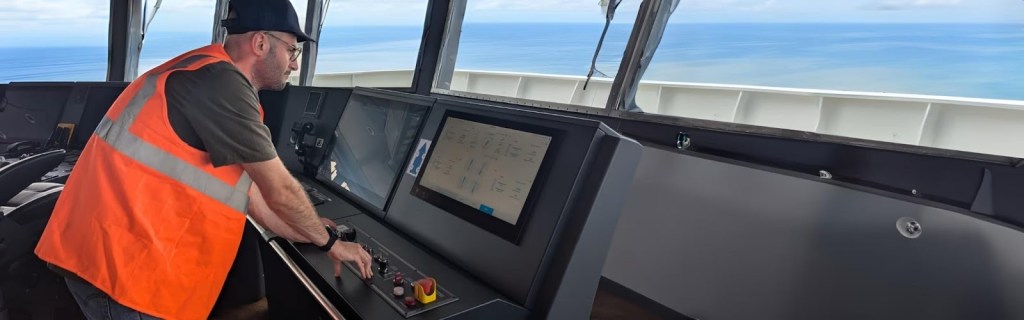
Image credit: oceanwings.com
Its fully automated design also eliminates the need for traditional sail handling, enhancing safety and ease of use for crews. However, the system comes with challenges: high upfront investment costs, structural modifications for installation, and maintenance of large moving parts can be significant barriers. Moreover, performance is highly weather dependent, meaning ships on routes with weak or inconsistent winds may see limited benefits. Despite these constraints, OceanWings’ scalability, class approvals, and proven efficiency make it a strong contender in the push for greener maritime operations.
OceanWings has built strong partnerships and client relationships to accelerate adoption of its wind-assisted propulsion systems, starting with its close collaboration with VPLP Design, which provided the naval architecture expertise behind the wingsail concept. The company has also secured key classification society approvals from Bureau Veritas, DNV, and ClassNK, ensuring compliance and trust for global deployment. On the client side, its flagship project is with ArianeGroup, whose logistics vessel Canopée was fitted with four OceanWings 363 sails to transport Ariane 6 rocket components across the Atlantic. In addition, OceanWings has partnered with investors such as SWEN Capital Partners’ Blue Ocean fund, Bpifrance, and Ocean Zero, whose support has been critical to scaling production and certification. These collaborations demonstrate both industry confidence and the strategic alliances necessary to bring wind propulsion into mainstream commercial shipping.
OceanWings (ex AYRO) is at the forefront of wind-assisted propulsion technologies for shipping. Its wingsail systems are maturing via demonstration, prototyping, sea trials, regulatory certification. They offer a viable path for shipowners to lower fuel and emissions, especially on suitable routes. The technology still faces challenges (capital cost, structural/operational constraints, environmental dependency), but with increasing regulatory pressure and rising fuel costs, wind propulsion is becoming more economically and environmentally viable.
References
OceanWings (ex AYRO) secures €19.2 million Series B financing round led by SWEN Capital Partners. (2023, September 26). OceanWings. Retrieved from https://www.oceanwings.com/news/ayro-secures-19-million-eu-series-b-financing-round oceanwings.com
OceanWings (ex AYRO) raises €10.5 million capital from Ocean Zero, Bpifrance and Mer Invest. (2021, September 13). OceanWings. Retrieved from https://www.oceanwings.com/news/ayro-raises-eu10-5-million-capital-from-ocean-zero-bpifrance-and-mer-invest oceanwings.com
OceanWings (ex AYRO) secures DNV GL Approval in Principle (AiP) for its OceanWings 3.6.3 wind-assisted propulsion system for ships. (2021, February 15). OceanWings. Retrieved from https://www.oceanwings.com/news/aip-oceanwings-363 oceanwings.com
OceanWings receives Approval in Principle from Bureau Veritas for innovative wind propulsion system in Athens. (2024, November 20). OceanWings. Retrieved from https://www.oceanwings.com/news/oceanwings-receives-approval-in-principle-from-bureau-veritas-for-innovative-wind-propulsion-system?utm_source=chatgpt.com oceanwings.com
OceanWings awarded AiP for wind-assisted propulsion system by ABS. (2024, December 5). Riviera Maritime Media. Retrieved from https://www.rivieramm.com/news-content-hub/news-content-hub/oceanwings-awarded-aip-for-wind-assisted-propulsion-system-83196
“Canopée gets its OceanWings”. (2023, August 18). Offshore-Energy.biz. Retrieved from https://www.offshore-energy.biz/canopee-gets-its-oceanwings/ Offshore Energy
OceanWings wingsail solution secures €19 million funding. (2023, September 27). Port Technology. Retrieved from https://www.porttechnology.org/news/oceanwings-wingsail-solution-secures-e19-million-funding/ Port Technology
OceanWings gets BV’s stamp of approval for its wind propulsion system. (2024, November 21). Offshore-Energy.biz. Retrieved from https://www.offshore-energy.biz/oceanwings-gets-bvs-stamp-of-approval-for-its-wind-propulsion-system/ Offshore Energy
Wikipedia contributors. (2025, March or so). Canopée. In Wikipedia. Retrieved from https://en.wikipedia.org/wiki/Canop%C3%A9e
 Scorpa's Tech @ Sea
Leave a comment