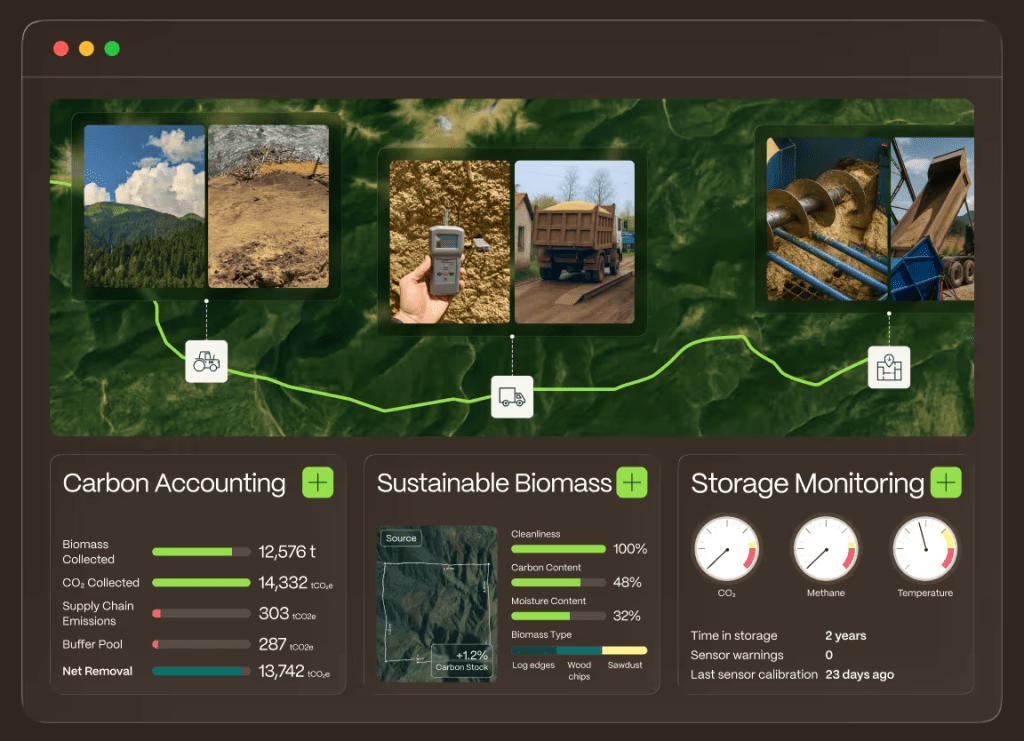
Image credit: rewind.earth
The maritime industry today faces growing scrutiny over its carbon footprint, with shipping responsible for nearly 3% of global greenhouse gas emissions. While efforts such as alternative fuels and wind-assist technologies are being developed, the industry still requires scalable solutions that address emissions not just onboard vessels but across the wider logistics chain. This is where Rewind, a carbon removal company based in Israel, offers a critical solution. By leveraging agricultural waste and natural aquatic ecosystems, the company presents a unique technology that directly benefits maritime operations, coastal resilience, and global carbon reduction efforts.
The background challenge lies in the vast quantities of carbon dioxide that remain in the atmosphere even after emission reductions, making carbon removal a necessary complement to decarbonization strategies. For the maritime sector, adopting such negative-emissions technology is vital to meet future IMO regulations and the demands of global supply chain stakeholders who are increasingly requiring climate accountability.
Rewind was founded by Ram Amar and has rapidly scaled from concept development to pilot projects in both Israel and Europe. Their vision has attracted scientists from marine ecology, carbon cycle research, and agricultural science, ensuring the company operates at the intersection of innovation and environmental stewardship.
Rewind has secured a diverse range of funding to fuel its mission. This includes $250,000 in R&D grants from Frontier, the carbon removal initiative launched by Stripe, and a $1 million grant from the Israeli Government Innovation Fund. On the venture capital side, Rewind has attracted backing from early-stage investors such as Yes VC and Propeller, a climate-tech fund focused on ocean solutions that collaborates with the globally respected Woods Hole Oceanographic Institution. Additional support has come from Frontier’s broader $1 billion commitment to scaling carbon removal, backed by major players like Stripe, Alphabet, Shopify, Meta, and McKinsey Sustainability. Rewind has also received investment from Third Derivative, a global accelerator for climate innovation, along with contributions from Mensch VC, Leap Forward Ventures, and Zora. This growing pool of capital is now enabling Rewind to scale up its efforts significantly with a new pilot project in development that’s expected to be 400 times larger than previous trials.
Rewind’s portfolio centers on its biomass sinking technology, which involves collecting agricultural residues such as crop stalks and shells, then transporting and depositing them in deep anoxic zones of seas and lakes. These natural conditions prevent decomposition and methane release, effectively locking away carbon for hundreds to thousands of years. For seafarers and shipping companies, this portfolio offers twofold benefits: it creates opportunities for sustainable cargo partnerships by transporting agricultural residues to deposition sites, and it enables shipping operators to directly participate in carbon removal initiatives, thereby offsetting their own emissions. Such involvement aligns vessels with future carbon credit markets and provides reputational advantages in an industry under constant pressure to decarbonize.
The technology operates through a simple yet highly effective process. Agricultural by-products, which are often burned or left to rot, are collected from farms and transported by ships or barges to designated aquatic sites. In these controlled zones, typically in the Eastern Mediterranean and similar deep-sea basins, the biomass is released to depths where oxygen is limited. In such conditions, microbial activity is suppressed, preventing the organic matter from breaking down and emitting greenhouse gases. Over time, the biomass becomes part of the sediment, storing carbon in a natural and stable form. The process leverages existing maritime logistics for collection and deposition, making it highly compatible with shipping networks. Its scalability rests on the vast supply of agricultural residues and the wide availability of suitable aquatic sites, positioning Rewind as a globally adaptable solution for climate mitigation in synergy with maritime transport.
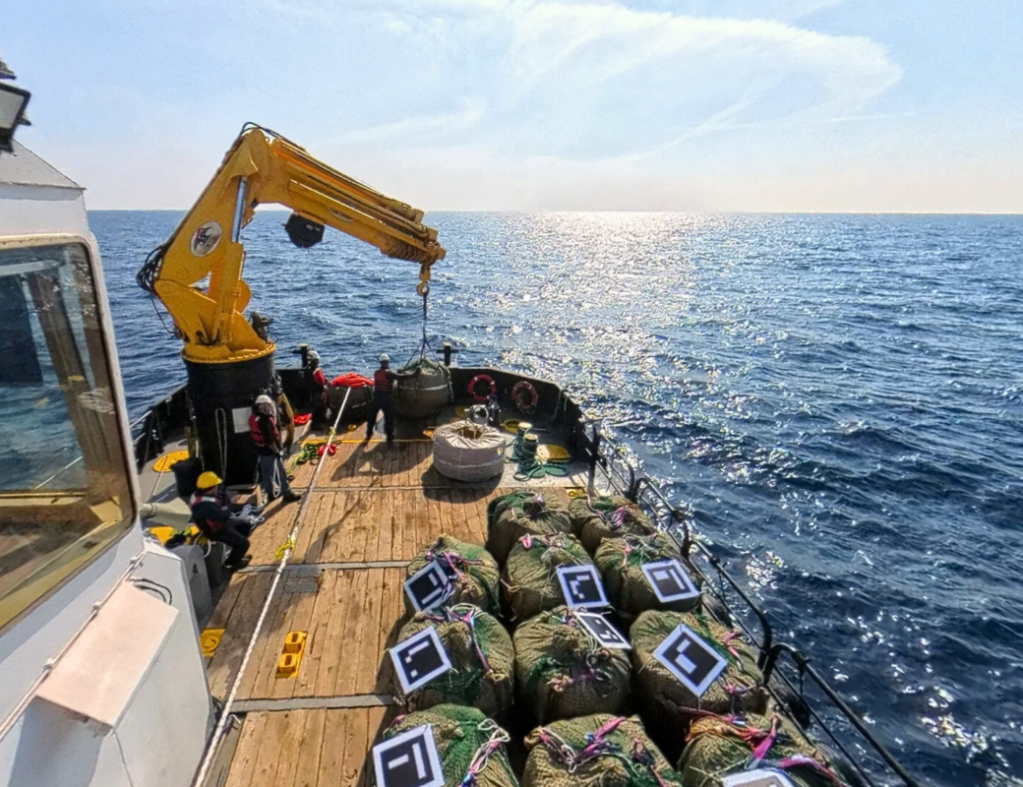
Image credit: rewind.earth
The advantages of Rewind’s solution include its relatively low cost compared to high-tech carbon capture systems, its reliance on natural ecological processes, and its potential for massive scalability. For the maritime sector, it offers a unique opportunity to integrate carbon removal into existing cargo operations, essentially turning ships into vectors of climate solutions.
Several pilot studies underscore Rewind’s potential. In 2022, the company conducted field trials in Israel’s freshwater bodies, successfully sinking agricultural biomass and monitoring its carbon stability over months. More recently, collaborations with European institutions have expanded these trials into marine contexts, testing the long-term sequestration potential under different depths and salinity conditions. Shipping companies have also participated by providing logistics support, helping prove the feasibility of integrating cargo transport with carbon sinking operations. These case studies illustrate that seafaring vessels can serve dual roles, not only transporting goods but also actively contributing to global carbon removal efforts.
Rewind has already established key collaborations with Tel Aviv University, the European Institute of Innovation & Technology (EIT Climate-KIC), and multiple agribusiness partners. On the client side, several corporate buyers, including Shopify’s Sustainability Fund and Stripe Climate, have contracted carbon removal credits from Rewind, helping finance ongoing deployments. These partnerships lend credibility and market validation, demonstrating that both scientific institutions and major corporations see value in the company’s approach. By aligning with shipping operators and logistics firms, Rewind is positioning itself as an essential link between agriculture, climate science, and maritime decarbonization.
References
Granit, E., & Druker, O. (2022). Rewind: Biomass Sinking for Carbon Sequestration. Nature-Based Solutions for Climate Change Mitigation, 4(2), 33–45.
Union Square Ventures. (2022). USV invests in Rewind for carbon removal. Retrieved from https://www.usv.com/blog/usv-invests-in-rewind
Soros Fund Management. (2023). Climate-Tech Portfolio Highlights. Retrieved from https://www.soros.com/portfolio
Stripe Climate. (2023). Our Carbon Removal Purchases. Retrieved from https://stripe.com/climate
Rewind. (2024). Technology Overview. Retrieved from https://rewind.earth
Contributor : Ariana Tri Asti
Reviewers : Imam Buchari, David Ratner

 Scorpa's Tech @ Sea
Leave a comment