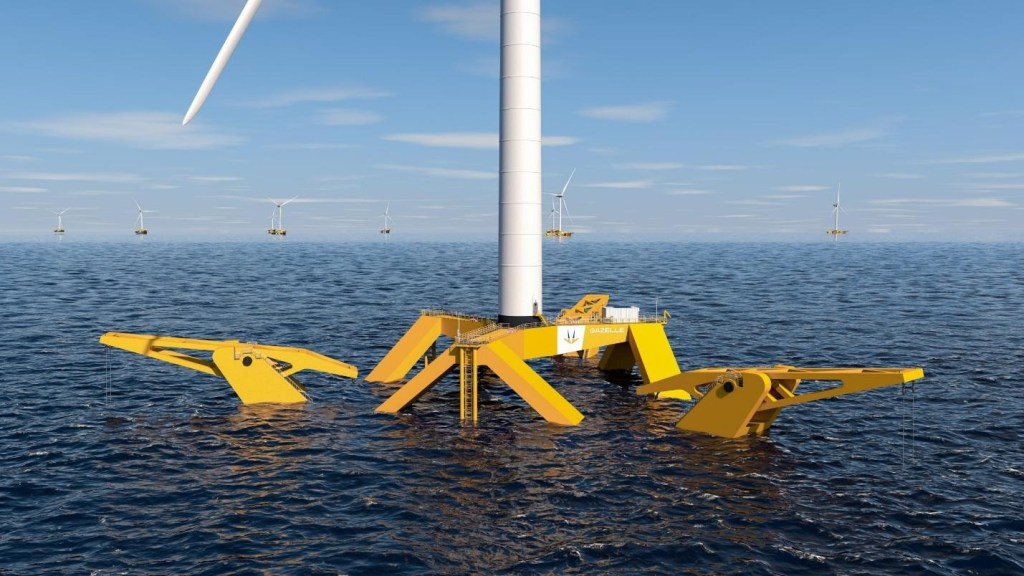
Image Credit: gazellewindpower.com
As the world faces growing demand for sustainable and reliable energy sources as it transitions toward carbon neutrality, offshore wind energy is one of the most promising solutions. However, deep-water installations remain a challenge due to complex mooring systems and high installation costs. Traditional bottom-fixed turbines are limited by depth and seabed conditions, which restricts deployment areas. Gazelle Wind Power addresses this issue through its innovative hybrid floating platform technology that enables wind farms to be installed in deeper and more turbulent waters. By combining the stability of a semi submersible structure and the flexibility of a tension leg platform, Gazelle’s system significantly reduces mooring loads and material costs. In maritime applications, such technology supports the growing demand for offshore renewable energy that can supply power to coastal facilities, ports, and offshore vessels.
Gazelle’s portfolio centers on its patented Hybrid Floating Platform (HFP), a modular system designed to support multi-megawatt offshore wind turbines. The platform’s unique configuration provides greater stability while significantly reducing installation time and maintenance costs. For maritime companies and seafarers, this technology translates to safer working environments and reduced downtime during harsh weather. Offshore maintenance vessels benefit from Gazelle’s ability to minimize platform motion, making operations more efficient. Moreover, by generating clean power near offshore installations, Gazelle’s system supports hybrid vessel charging, desalination plants, and offshore aquaculture, thus contributing to a greener maritime ecosystem.
Gazelle Wind Power’s hybrid floating platform operates as a three-body structure combining a semi-submersible base, a central spar, and tensioned mooring lines. The system uses a hydrodynamic stabilization approach, which balances buoyancy and tension to maintain optimal positioning even in high wind and wave conditions. The technology’s modular design allows it to be scaled for turbines exceeding 15 MW capacity. The structure is towed to site using conventional vessels, reducing logistics and installation costs. Once in position, the hybrid mooring system ensures minimal pitch and heave, enabling turbines to operate with maximum efficiency. In maritime applications, this system provides a robust energy platform for offshore operations such as drilling rigs, maritime traffic monitoring, and coastal grid supplementation. Gazelle’s floating design also allows redeployment to different regions, making it adaptable for global wind energy needs.
The advantages of Gazelle’s hybrid floating platform are numerous. It offers unmatched stability, cost efficiency, and scalability compared to traditional floating or bottom fixed designs. Its reduced mooring tension decreases stress on anchors and cables, lowering maintenance needs. Furthermore, the system can be easily assembled and transported using standard maritime infrastructure. From an environmental perspective, Gazelle’s reduced seabed footprint minimizes ecological disruption. However, challenges remain, particularly the high initial capital cost of their floating platforms and the complex certification processes required for large scale offshore deployments. Additionally, supply chain limitations for specialized mooring components can cause project delays. Nevertheless, Gazelle’s engineering breakthroughs and operational maturation continue to mitigate these issues.
One of Gazelle’s most significant milestones is its pilot project in Portugal’s deep Atlantic waters, developed in partnership with INESC TEC and EDP Renewables. This demonstration aims to validate the platform’s performance under real maritime conditions and gather data on mooring efficiency and dynamic response. Another use case is Gazelle’s participation in the ORE Catapult program in the United Kingdom, where its platform design has been tested for scalability and grid compatibility. The technology has also been evaluated in Spain’s BIMEP test site, where results showed up to 30% reduction in mooring stress compared to conventional systems. These cases underscore Gazelle’s commitment to delivering reliable offshore energy solutions applicable to both renewable developers and maritime energy providers.
Gazelle Wind Power was founded by a multidisciplinary team led by Jon Salazar who currently serves as CEO. The company was established with the vision of transforming offshore wind energy through innovation in floating technologies. Other notable contributors include Dr. Javier Cavada, a veteran of Wärtsilä and president of Mitsubishi Power EMEA, who serves as a board member, and William “Bill” Simonds, who has decades of experience in marine construction and naval architecture. Their combined expertise in engineering, finance, and energy systems laid the foundation for Gazelle’s cutting edge approach to floating wind platforms.
Gazelle Wind Power has successfully attracted funding from multiple investors focused on sustainable and maritime energy innovation.
- June 2021: Gazelle raised €10.5 million in a seed funding round led by Equinor Ventures, Shell Ventures, and TechEnergy Ventures (part of the Tecpetrol Group).
- March 2022: The company secured an additional €8 million from a consortium of maritime and energy-focused investors to expand prototype testing in European waters.
- 2023: Gazelle announced new strategic partnerships with investment entities in Ireland and Portugal as part of a funding program exceeding €20 million, aimed at pilot deployment in the Atlantic Ocean.
These funds have been pivotal in scaling the company’s R&D, improving the reliability of their platform, and accelerating commercialization efforts in offshore wind projects.
Gazelle Wind Power has also established strategic collaborations with industry leaders and research institutes worldwide. Key partnerships include Indico capital, Equinor, Shell Ventures, Mitsubishi Power, INESC TEC, and ORE Catapult. The company also works with Lloyd’s Register for certification and design verification. Major clients and project stakeholders include EDP Renewables, Repsol, and Ocean Winds, all of whom are exploring Gazelle’s floating platform for large-scale offshore wind farms. These collaborations highlight Gazelle’s position as a pivotal enabler in the global transition to sustainable offshore power generation.
References
Gazelle Wind Power. (2023). Official website. Retrieved from https://gazellewindpower.com
Equinor Ventures. (2021). Gazelle Wind Power investment announcement. Retrieved from https://www.equinor.com
ORE Catapult. (2023). Floating wind platform performance evaluation report. Retrieved from https://ore.catapult.org.uk
INESC TEC. (2022). Gazelle Wind Power collaboration for deep-water wind trials. Retrieved from https://inesctec.pt
Shell Ventures. (2021). Investment in Gazelle hybrid floating wind platform. Retrieved from https://www.shellventures.com
 Scorpa's Tech @ Sea
Leave a comment