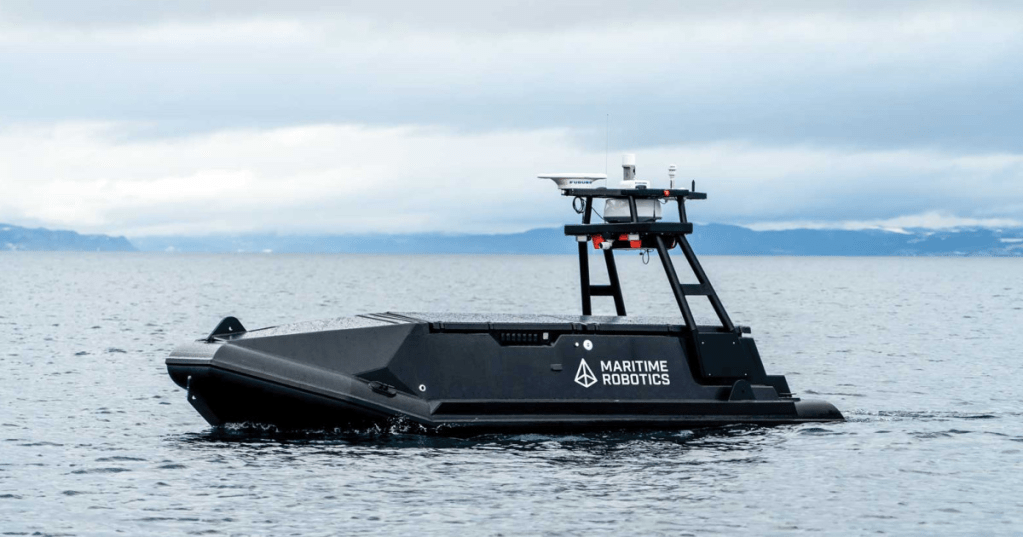
Image Credit: maritimerobotics.com
Imagine the ocean as a vast, unpredictable workplace where every shift feels like an extreme-survival expedition. Crews face dangerous weather, costly vessel operations, drain budgets faster than a leak in the hull, and the demand for high-quality marine data keeps growing like a relentless tide. Traditional vessel deployments are heavy on fuel, risky for people, and painfully slow for modern ocean-driven industries. These are the pain points that keep maritime operators awake at night: safety hazards, ballooning operational costs, limited data visibility, and a constant struggle to reach remote or high-risk waters efficiently. This is where Maritime Robotics unfurls its sails.
Maritime Robotics is a Norwegian maritime technology company headquartered in Trondheim, Norway, founded in 2005 by Vegard Evjen Hovstein. The company was established to transform the maritime industry through the creation of advanced autonomous systems, including Unmanned Surface Vehicles (USVs) and Unmanned Aircraft Systems (UAS). The motivation behind this innovation lies in addressing long-standing challenges in ocean operations from high operational costs and human safety risks to the demand for precise, real-time marine data collection. Traditional vessel based operations often expose crews to harsh conditions, while also consuming vast resources. By developing remotely operated and fully autonomous maritime systems, Maritime Robotics enables safer, more sustainable, and efficient ocean missions, bridging the gap between environmental responsibility and operational excellence.
In 2024, Maritime Robotics announced a USD 12 million capital raise. The funding round was co-led by the Nordic cleantech fund NRP Zero and the Norwegian state-owned fund Nysnø Climate Investment, with significant participation from Umoe AS and Holta Invest. The round also saw strong support from employees and existing shareholders.
Maritime Robotics has responded to real-world pains with purpose-built Unmanned Surface Vehicles, most notably the Otter and the Mariner, each crafted to take on the ocean’s many moods while keeping human hands dry, budgets lean, and insights flowing in real time :
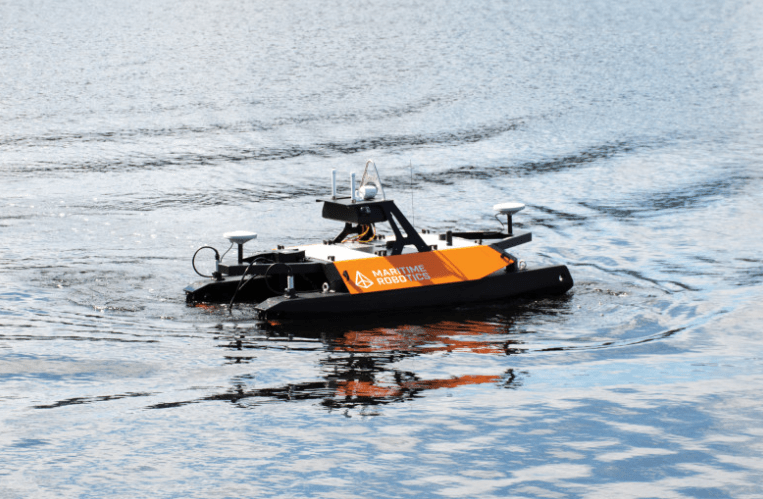
- The Otter USV features a compact, modular catamaran hull that can be split into sub-20 kg components for easy transport, and is engineered for sheltered and coastal waters. Its all-electric propulsion (powered by four battery packs and twin thrusters) enables emission-free operation of up to about 20 hours under favourable conditions. The plug-and-play sensor interface accommodates sonar, LiDAR, camera and environmental payloads, while its Vehicle Control Station (VCS) supports autonomous waypoint navigation, real-time data visualisation and remote/manual control.
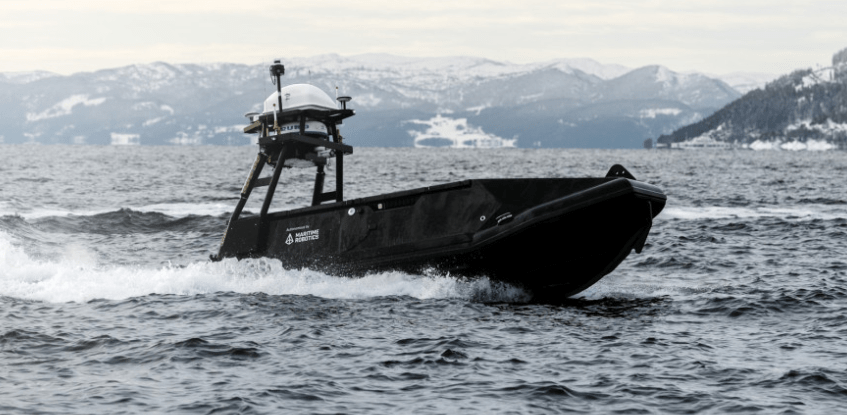
- The Mariner USV is a mid-sized, rugged vessel intended for both coastal and open-water operation, built with a high-density polyethylene hull (near-unsinkable and low-maintenance) and featuring water-jet propulsion plus bow thrusters for high manoeuvrability. It supports substantial payloads (≈400 kg or more), includes a large payload bay (or moon-pool/elevator option for subsurface sensors), high-bandwidth communication links (LTE/4G, optional Starlink) and can be deployed from standard containers or trailers, thus enabling remote, autonomous or remote-controlled missions in challenging marine environments.
The technology developed by Maritime Robotics integrates autonomous navigation systems, real time sensor fusion, GNSS positioning, and secure data links. These allow for real-time mission execution and data collection without the need for onboard personnel. The USVs and UAS autonomously follow pre-programmed routes, gather sonar, LiDAR, or camera data, and transmit it to shore-based command centers for analysis. This approach drastically reduces operational costs and minimizes human exposure to dangerous conditions at sea. Development of autonomous maritime systems to improve efficiency, safety, and sustainability used in high-risk or data intensive marine operations in offshore zones, coastal areas, and research environments utilized by defense agencies, energy companies, and marine researchers through AI powered navigation and remote control systems integrated with advanced maritime sensors.
The advantages of Maritime Robotics’ technology are significant. It enhances operational safety by eliminating the need for onboard crews, reduces fuel consumption, cuts maintenance costs, and provides precise real-time data. Its adaptability allows for use across various sectors, from scientific research to defense and commercial shipping. However, there are also challenges, including high upfront investment, the need for stable communication networks, cybersecurity concerns, and evolving international regulations regarding unmanned vessel operations. Operators must also undergo specialized training to integrate autonomous systems with conventional fleet operations. Despite these challenges, the long term advantages make Maritime Robotics a key player in shaping the autonomous maritime future.
Several case studies highlight the practical success of its technology. In collaboration with the Norwegian Institute for Water Research, Maritime Robotics deployed autonomous USVs for coastal monitoring and water-quality assessment in Norwegian fjords, achieving high accuracy without manned vessels. Partnering with Equinor, the company supported offshore energy inspections, improving operational safety and efficiency. In defense, Maritime Robotics’ systems have been used in NATO maritime security exercises for coastal surveillance and rapid-response missions. The company’s strong partnerships with Kongsberg Gruppen and Norwegian Defence Research Establishment have further strengthened its technological influence. Through these collaborations, Maritime Robotics continues to empower companies, researchers, and governments to operate more safely, efficiently, and sustainably in the maritime domain.
Final thoughts
As global demand for safer, smarter, and more sustainable ocean operations grows, Maritime Robotics stands at the forefront of maritime innovation. By transforming how marine data is collected and how offshore missions are executed, the company is not only solving today’s operational challenges but also shaping a future where autonomy becomes a central pillar of maritime security, scientific discovery, and industrial progress.
References
Maritime Robotics. (n.d.). Official website. Retrieved from https://www.maritimerobotics.com
Norwegian Institute for Water Research. (2022). Coastal monitoring using autonomous surface vehicles. Journal of Ocean Technology, 17(3), 54–67. Retrieved from https://niva.no
Equinor. (2023). Offshore energy inspection and monitoring program. Offshore Energy Review, 29(4), 112–118. Retrieved from https://www.equinor.com
Hovstein, V. E. (2020). Autonomous maritime systems: Safety and operational benefits. Trondheim: Norwegian Technical Press. Retrieved from https://ntnu.no
Kongsberg Gruppen. (2023). Strategic partnerships in maritime autonomy. Retrieved from https://www.kongsberg.com
NATO. (2022). Autonomous systems in maritime security operations. NATO Research Publication Series. Retrieved from https://www.nato.int


Leave a comment