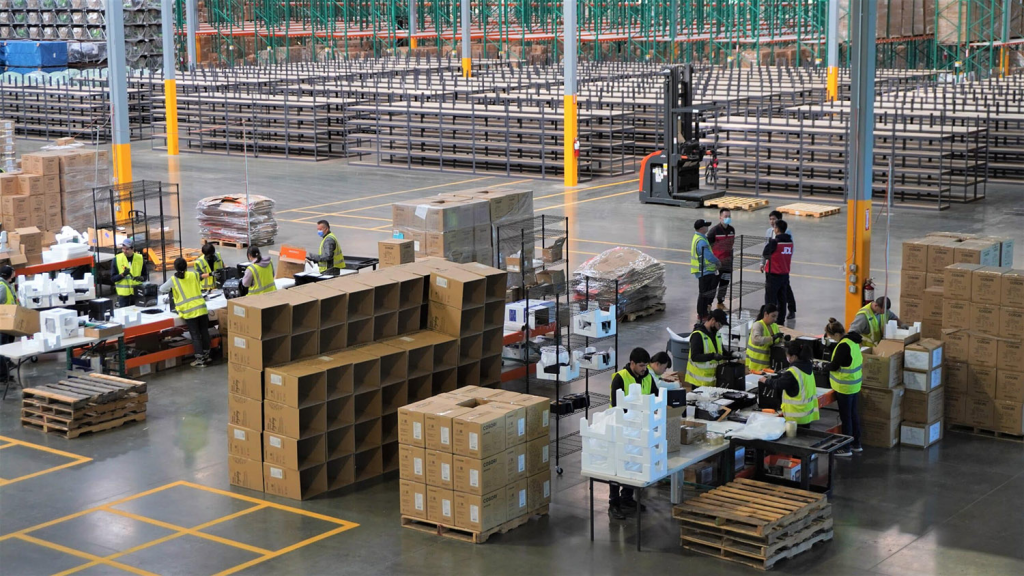
Jingdong Logistics, the logistics subsidiary born from JD.com, has evolved from an internal delivery arm into one of the world’s largest technology-driven logistics companies. As international trade accelerates and maritime transport becomes increasingly intertwined with global e-commerce, traditional logistics systems face mounting challenges: limited visibility, slow manual processes, and inefficiencies at port-to-warehouse transitions. Jingdong Logistics addresses these issues by combining automation, robotics, data-driven routing, and Digital Twin Supply Chain (DTSC) systems. In maritime applications, these technologies are needed to reduce port congestion, speed up container handling, improve cross-border coordination, and enhance end-to-end shipment traceability from vessel to inland distribution.
Jingdong Logistics traces its origins to JD.com founder Richard Liu Qiangdong, who established the logistics division in 2007 to support JD’s rapidly growing e-commerce ecosystem. In 2016, the logistics department became an independent company, eventually led by key industry figures including Hu Wei, the current CEO. These leaders positioned the company as a technology-first logistics provider that blends big-data analysis with advanced automation across global supply chains.
Jingdong Logistics entered a major expansion phase when it officially spun off from JD.com and pursued external capital through its landmark Initial Public Offering (IPO) on the Hong Kong Stock Exchange in May 2021. The IPO raised approximately US$3.2 billion, making it one of the largest logistics-tech listings in Asia that year and attracting a broad mix of institutional investors across technology, infrastructure, and global supply-chain sectors. As a publicly traded company under stock code 2618.HK, Jingdong Logistics no longer relies on traditional venture capital; instead, its funding growth now comes from public-market investors, strategic partners, and reinvested operating revenue. This influx of capital has allowed the company to expand its robotics-enabled warehouses, build cross-border logistics corridors, strengthen maritime-linked freight services, and scale its digital twin supply-chain platform, cementing its status as a leading technology-driven logistics infrastructure provider.
Jingdong Logistics’ technology ecosystem functions as an integrated digital backbone that supports maritime operations through its Digital Twin Supply Chain (DTSC) platform, automated warehouse robotics, and intelligent routing systems. It works by creating a real-time virtual model of the entire logistics chain, showing what is happening with cargo as it moves from ship to port, through customs, into warehouses, and onward to inland distribution.
This technology is needed because maritime supply chains often face unpredictable delays, port congestion, inventory mismatches, and limited visibility across borders. It is applied before vessels arrive to forecast capacity, during unloading to optimize container allocation, and after departure to streamline last-mile delivery and replenishment cycles. It operates across port terminals, bonded warehouses, overseas fulfillment centers, and cross-border shipping corridors, offering a unified data layer that connects sea freight with air and land networks. The system benefits shippers, freight forwarders, port authorities, and maritime logistics planners by enabling data-driven decision-making and fast response to real-time disruptions. It functions through continuous streams of IoT data, AI forecasting engines, robotics, and automation, which together simulate scenarios, recommend optimal routing strategies, and synchronize maritime and inland logistics into a single intelligent workflow.
Jingdong Logistics offers several strengths for maritime and global supply chain users. Its automated storage robots, intelligent routing, and digital twin modeling dramatically speed up cargo processing, increasing accuracy and reducing labor-intensive workflows. The integrated multimodal network creates seamless transitions between sea freight and inland delivery, which is vital for reducing port congestion and protecting shipping schedules. The ability to predict demand and optimize capacity further supports the resiliency of supply chains exposed to volatile maritime conditions.
Jingdong Logistics strengthens its global reach through a network of strategic partnerships that enhance both maritime and cross-border logistics performance. Its collaboration with Agility Logistics in the Middle East expands multimodal sea-air-land corridors, enabling faster transit for international e-commerce shipments moving through major maritime gateways. The company also operates its own freight airline, Jiangsu Jingdong Cargo Airlines, which connects seaborne cargo flows with high-speed air distribution hubs, creating a seamless bridge between ports and inland destinations. Across Europe, Southeast Asia, and the United States, JD’s overseas fulfillment centers work closely with local port operators, customs authorities, and third-party logistics firms to streamline vessel-to-warehouse handovers and improve delivery reliability. These partnerships support major clients including global manufacturers, cross-border e-commerce sellers, retail brands, and large supply-chain integrators who depend on JD’s automated warehouses, predictive logistics technologies, and integrated transport network to manage high-volume international shipments with precision and speed.
Final Thought
As global trade becomes increasingly interconnected and maritime logistics grow more complex, Jingdong Logistics demonstrates how technology can redefine the movement of goods across oceans and borders. By integrating digital twins, automation, multimodal routing, and strategic global partnerships, the company is shaping a new standard for visibility, speed, and resilience in maritime-connected supply chains. Its continued expansion from robotics-enabled hubs to cross-border corridors signals a broader shift toward intelligent logistics infrastructure that anticipates disruption rather than reacts to it. In an era where every hour of delay impacts global commerce, Jingdong Logistics stands as a blueprint for how the future of maritime logistics will be built: data-driven, seamlessly connected, and powered by next-generation technology.
References
Abdillah, M. R. N., & Wahyuilahi, M. (2024). Digital twin technology in logistics: A narrative review of implementation, impact, and challenges. Sinergi, 2(4).
Sinergi International Journal: https://sinergijournal.com
Li, S. Y. (2023). Research on the innovation of logistics system of e-commerce — Taking JD Logistics as an example. (Case study).
ResearchGate: https://www.researchgate.net
JINGDONG Logistics. (2024). 2024 ESG Annual Report.
Official website: https://www.jingdonglogistics.com
JINGDONG Logistics. (2020, August 14). Digital Twin Supply Chain White Paper.
JD Corporate Blog: https://blogs.jd.com
JD Corporate Blog. (n.d.). Press releases on international expansion and service network.
JD Corporate Blog: https://blogs.jd.com
Wikipedia contributors. (2025). JD Logistics. In Wikipedia.
https://en.wikipedia.org/wiki/JD_Logistics


Leave a comment