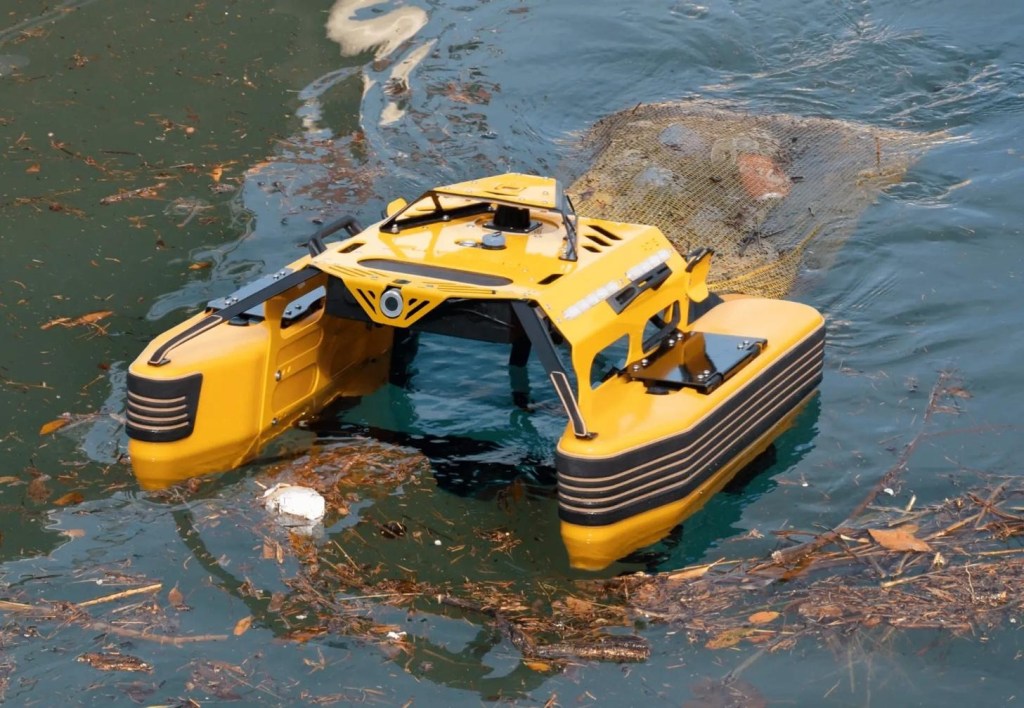
Image source: www.gocapital.fr
Traditional cleanup methods require significant manpower, create safety risks for crews, and often cannot access narrow or shallow areas where pollution accumulates most heavily. IADYS responded to this operational gap by developing the Jellyfishbot, a compact, electric autonomous surface robot capable of navigating confined waters, collecting debris, and monitoring environmental parameters without requiring direct human involvement.
IADYS, a French marine-technology company founded in 2016 by robotics specialist Dr. Nicolas Carlési, has emerged as a leading innovator in autonomous solutions for water-surface pollution control. The company was established to address the urgent environmental challenge posed by floating waste, microplastics, biomass, and hydrocarbon residues that collect around ports, marinas, industrial basins, and sheltered waterways.
Dr. Carlési’s vision for IADYS was shaped by his background in underwater robotics and his personal experience as a diver observing pollution in coastal waters. Under his leadership, IADYS attracted growing interest from investors committed to sustainable innovation. In 2021, the company secured €1.57 million in financing from Région Sud Investissement, Aviva Impact Investing France, France Active Investissement, Sud Mer Invest, and Angel’s Bay Invest. This investment accelerated the development of advanced navigation features and sensor integrations. The company continued to expand, raising an additional €10 million in 2024 through a Series A round led by GO CAPITAL and Innovacom, enabling industrial-scale production and the launch of a U.S. subsidiary in Houston to support the growing demand for autonomous environmental monitoring in American industrial and port facilities.
The Jellyfishbot and its enhanced version, the Jellyfishbot Expert, form the core of the company’s portfolio. These robots collect floating debris through mechanical nets and absorbent systems designed for both waste and hydrocarbon recovery. Operators in ports, marinas, and industrial sites deploy the robots for routine surface cleaning, environmental maintenance, and post-spill response operations. The robots can also be equipped with LiDAR, sonar, and water-quality sensors that allow them to map underwater topography and monitor environmental conditions. Through integrated navigation software and artificial intelligence, these systems operate autonomously, maneuver around vessels and infrastructure, and gather data that assists facility managers in making better decisions regarding dredging, maintenance, and environmental compliance. Because the robots operate electrically and silently, they reduce emissions, reduce the disturbance of marine life, and eliminate the safety risks associated with sending staff onto the water in small boats.
The benefits of IADYS technology are myriad, particularly for organizations that must maintain clean and safe water surfaces while managing limited manpower. The robots reduce the reliance on manual skimming, increase the frequency of surface cleaning, and improve the consistency of environmental monitoring. They also help companies comply with tightening environmental regulations and reduce the risk of pollution events spreading beyond local boundaries.
Real-world deployments show how the technology performs in diverse conditions. In coastal France, marinas in Cassis, Cannes, and Marseille rely on Jellyfishbots for daily cleanup of fuel residues, packaging waste, and organic matter drifting between yachts. In the United States, industrial plants in Texas and Louisiana have used the robots to recover plastic pellets and oil sheen from stormwater basins while simultaneously gathering bathymetric and water-quality measurements. Universities such as the Université du Littoral Côte d’Opale employ the robots for scientific studies on microplastic dispersion, improving the accuracy and repeatability of sampling campaigns. Municipal agencies in Tokyo and Fairhaven use the technology for urban waterway cleaning and educational demonstrations, showing how robotics can support sustainability in public environments.
To widen the reach of its solutions, IADYS has developed strong collaborations with major industrial clients and global partners. Companies such as ExxonMobil, Dow Chemical, and BAE Systems deploy the robots for ongoing water-surface management and pollution-prevention strategies. International distributors in Asia-Pacific, Europe, and the Middle East expand access to the technology, while environmental research programs through European institutions further strengthen its scientific applications. Through these partnerships, IADYS continues to position itself as an influential player in the global effort to modernize maritime environmental protection and to support cleaner, safer waters worldwide.
Final thought
IADYS demonstrates how autonomous robotics can shift maritime environmental protection from reactive cleanup to continuous, data-driven prevention. By replacing labor-intensive and risky manual operations with intelligent, electric surface robots, the company enables ports, industries, and municipalities to maintain cleaner waterways while improving safety, regulatory compliance, and environmental insight. As pollution control and monitoring become inseparable from modern port and industrial operations, IADYS’s technology shows that scalable robotics can play a decisive role in protecting coastal ecosystems and setting a new standard for sustainable water-surface management worldwide.
References
Easy Engineering Magazine. (2024). IADYS continues to break into the U.S. market. https://easyengineering.eu/iadys-continues-to-break-into-the-us-market/
IADYS. (2024). Corporate presentation 2025. IADYS. https://www.iadys.com
IADYS. (n.d.). Jellyfishbot – Autonomous surface robot. https://www.iadys.com/jellyfishbot/
Le Journal des Entreprises. (2025). IADYS opens U.S. subsidiary after €10M funding round. https://www.lejournaldesentreprises.com
Maddyness. (2024). IADYS raises €10 million to industrialize maritime cleaning robots. https://www.maddyness.com
Marine Industry News. (2021). Jellyfishbot expands global presence in the maritime sector. https://marineindustrynews.co.uk
Petites Affiches. (2021). IADYS secures €1.57M to accelerate autonomous marine robotics development. https://www.petitesaffiches.fr
Sustainable Smart Marina. (2025). IADYS portfolio overview. https://sustainablesmartmarina.com
Université du Littoral Côte d’Opale. (2023). Microplastic sampling using autonomous surface vehicles. https://www.univ-littoral.fr
 Scorpa's Tech @ Sea
Leave a comment