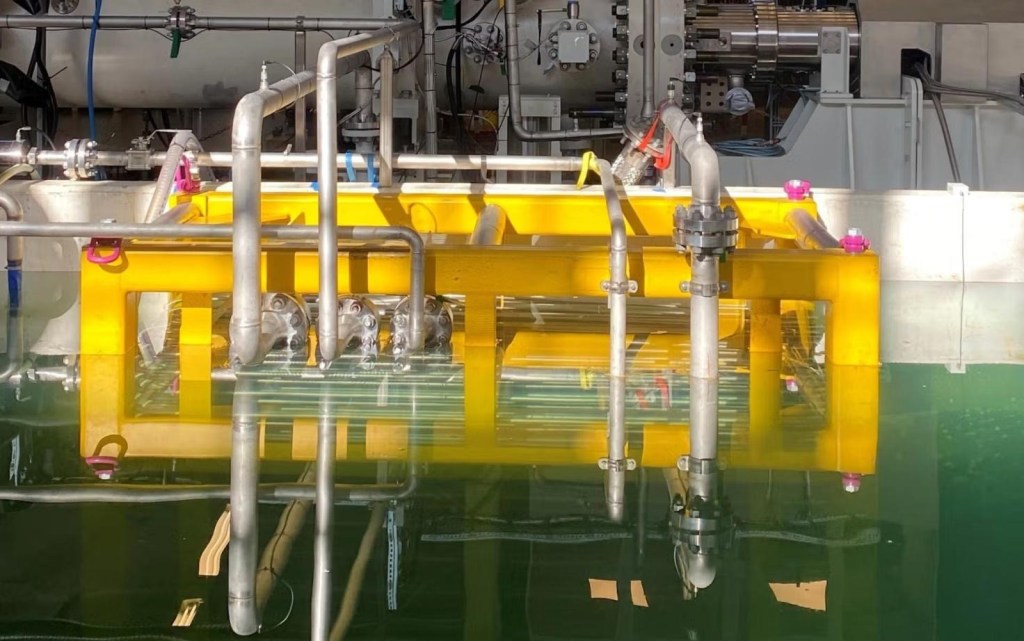
Image credit: flocean.green
Freshwater is becoming harder to secure, especially for coastal ports, offshore platforms, and island communities that depend on reliable supply. Traditional desalination plants take up large areas of land, consume high amounts of energy, and can harm the environment, making them difficult to use in maritime settings. The world needs a smarter solution that doesn’t overload the coast or the climate. Flocean is stepping in with a new approach: taking desalination underwater by using the natural pressure of the deep sea to help turn seawater into freshwater.
Flocean AS, a Norwegian clean tech company headquartered in Oslo, is pioneering a revolutionary approach to water production through its subsea desalination technology. Emerging as a spinout from FSubsea AS, a company with deep roots in subsea engineering, the startup was founded by Alexander Fuglesang, a fifth generation engineer from Norway’s renowned Fuglesangs family. Flocean’s mission is clear: to solve the global water scarcity crisis by leveraging the natural hydrostatic pressure of the deep sea. As the world faces an estimated 40% freshwater shortfall by 2030, traditional desalination systems, often energy intensive and environmentally harmful, have proven inadequate for maritime and coastal industries. Flocean’s innovative subsea system addresses these limitations by moving desalination operations offshore between 300 and 600 meters below the surface, where the cold, high pressure, low-biomass seawater naturally aids the filtration process. This is particularly valuable for maritime applications such as ports, offshore platforms, coastal shipyards, and island-based terminals that rely heavily on sustainable and resilient freshwater sources.
The company’s funding milestones have positioned it for global expansion. In December 2024, Flocean secured approximately NOK 90–100 million (USD 8–9 million) in a Series A round led by Burnt Island Ventures, Nysnø Climate Investments, and Freebird Partners, with participation from Katapult Ocean, MP Pensjon, and former Bridgewater Associates executives. These funds are aimed at scaling commercial deployment of its modular desalination pods, each capable of producing up to 5,000 m³ of water per day. The modular design enables scalability, systems can expand up to 50,000 m³/day for industrial or maritime applications.
Technically, Flocean’s subsea desalination process is a sophisticated application of reverse osmosis adapted to deep sea conditions. The system draws in seawater at depths where natural pressure around 40–50 bar significantly reduces the mechanical energy required for filtration. This high pressure environment, combined with low algae and organic content, minimizes pre treatment needs and eliminates many of the ecological downsides associated with surface plants, such as brine discharge and chemical pollution. Operating autonomously and unaffected by storms or surface events, these subsea modules can supply coastal cities, port facilities, and offshore fleets with freshwater through underwater pipelines.
Flocean’s journey has been shaped by several strategic partnerships that bring its subsea desalination vision to life within the maritime world. One of the most notable collaborations is with the Male’ Water & Sewerage Company in the Maldives, where both parties are exploring deep-sea desalination to strengthen water security for island communities surrounded by the ocean yet vulnerable to freshwater scarcity. The partnership reflects a powerful maritime connection: leveraging the deep ocean’s natural pressure and purity while minimizing coastal environmental impact. Flocean also works alongside Siemens Energy, combining expertise in offshore energy infrastructure with next-generation subsea water production. This alliance underlines how the future of water innovation is moving beneath the waves, supported by technologies historically used in marine and offshore operations. In the Middle East, Flocean has partnered with the Sahara Forest Project and Aqaba Water Company to deploy desalination systems in the Bay of Aqaba, highlighting how maritime engineering can supply sustainable freshwater for agriculture in arid regions. Together, these partnerships showcase the growing momentum of ocean-based utilities and the vital role of maritime collaboration in addressing global water challenges.
Final Thoughts
Flocean steps in with a new approach: taking desalination underwater. By placing modular desalination systems 300 to 600 meters below the surface, Flocean reduces energy use and environmental impact while delivering a stable and sustainable water source directly to maritime and coastal operations. Looking ahead, the global demand for freshwater will only intensify, and maritime industries cannot afford to rely on outdated solutions. Innovations like Flocean’s show how the ocean itself can become part of the answer. As subsea desalination scales up, it has the potential to reshape how coastal regions and offshore sectors access water: cleaner, more secure, and built for a future where sustainability is no longer optional.
References
Flocean AS. (n.d.). Home. Retrieved from https://www.flocean.green
Flocean AS. (2024, March). New data validates commercial readiness of subsea desalination. Retrieved from https://www.flocean.green/post/flocean-milestone-new-data-validates-commercial-readiness-of-subsea-desalination
Nysnø Invest. (2024, December 11). Nysnø invests in the Norwegian water technology company Flocean. Retrieved from https://www.nysnoinvest.no/nysno-invests-in-the-norwegian-water-technology-company-flocean
Burnt Island Ventures. (2024, December 10). Why we invested in Flocean. Retrieved from https://www.burntislandventures.com/the-blog/brgn6gb279058tw3mz92qojebq7b75
Maritime Technology News. (2024, December 19). Flocean aims to transform desalination with subsea technology. Retrieved from https://www.marinetechnologynews.com/news/flocean-transform-desalination-subsea-643519



Leave a comment