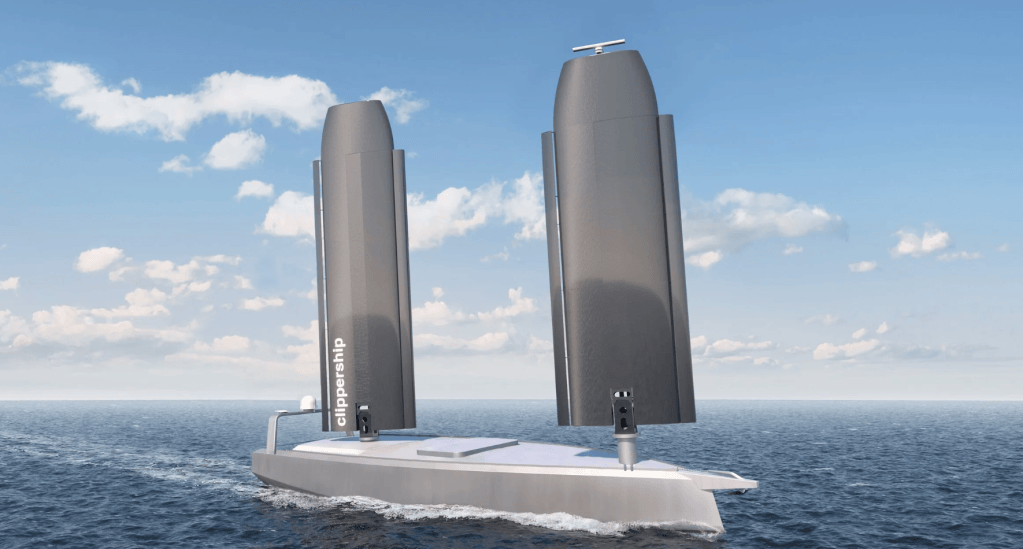
Image Source: clippership.co
In the 1850s, clipper ships were the fastest merchant vessels on the ocean, designed to move high-value cargoes across the globe with speed and agility. Today, a Los Angeles-based robotics startup of the same name is reviving that spirit for the 21st century, not with sails and wooden hulls, but with marine robotics, rigid-wing technology, and autonomous navigation.
Clippership is a marine robotics company on a bold mission: to transform ocean logistics into a sustainable, distributed, and democratized network. By deploying a fleet of small, autonomous, wind-powered vessels, the company aims to bypass the friction of massive deepwater ports and the high-carbon footprint of traditional container shipping.
Background: Breaking the “ISO Container” Monopoly
The traditional maritime industry is built on a “bigger is better” philosophy, relying on massive ships and specialized deepwater infrastructure. This centralizes trade into a few mega-ports, often requiring long-haul trucking to reach final destinations.
Clippership challenges this model by focusing on pallet-based logistics. Their vessels move palletized cargo on optimized point-to-point routes, allowing them to access smaller ports that are geographically closer to producers and consumers. This “distributed network” approach aims to reduce warehouse-to-warehouse transit times and drastically cut carbon emissions.
Founders & Leadership: From a Garage to the Open Sea
Clippership was founded by brothers Nico and Luca Cymbalist, alongside Kai Matsuka. The company famously began in a garage in Los Angeles, combining the founders’ backgrounds in engineering and robotics to solve the “last mile” and sustainability problems of transoceanic trade.
The founders’ vision is rooted in Phased-in Autonomy. They aren’t just building ships; they are building a robotic platform. Initial voyages are designed with minimal supervision as they gather data to transition toward fully uncrewed, remotely monitored operations in alignment with the emerging Maritime Autonomous Surface Ships (MASS) Code.
The Fleet: Wind-Propelled Marine Robotics
The core of the Clippership offering is its purpose-built autonomous vessels, designed for high throughput and ultra-low operating expenses (OPEX).
- The 24-Meter Class: Launching in 2026, this vessel features twin, foldable rigid wings for primary wind propulsion and a cargo capacity of 75 Euro-pallets within a climate-controlled hold.
- Zero-Emission Propulsion: By harnessing wind energy as the primary driver, Clippership dramatically shrinks the fuel costs and carbon footprint typically associated with fossil-fuel-powered freighters.
Strategic Partners & Investors: A Foundation of Engineering and Vision
To bring their vision to life, Clippership has assembled a Tier-1 network of maritime engineering partners and world-class venture backing:
- Fifty Years: As a lead investor focused on “deep-tech” companies solving the world’s biggest problems, Fifty Years provides the strategic backing for Clippership to achieve large-scale climate impact through maritime decarbonization.
- Founders Factory: Through its accelerator and investment programs, Founders Factory assists Clippership in operational scaling and provides access to a global corporate network to accelerate the adoption of autonomous logistics.
- Dykstra Naval Architects & KM Yachtbuilders: Renowned Dutch naval architects and shipbuilders providing the structural expertise and innovative aluminum construction for the fleet.
- Glosten & RINA: American marine engineering firm and international classification society ensuring the fleet meets the highest safety and regulatory standards.
Final Thought: Stability and Sustainability in a Distributed Network
Clippership represents a return to “nimble” trade. By decoupling ocean logistics from the volatility of fuel prices and the bottlenecks of large-port infrastructure, they are offering a more resilient supply chain solution.
With the backing of high-impact investors like Fifty Years and Founders Factory, Clippership is not just launching a ship, it is launching a replicable and scalable model for sustainable, point-to-point shipping. In an era where global trade must become greener and more reliable, Clippership is ensuring that the future of logistics is autonomous, wind-powered, and carbon-neutral.


Leave a comment