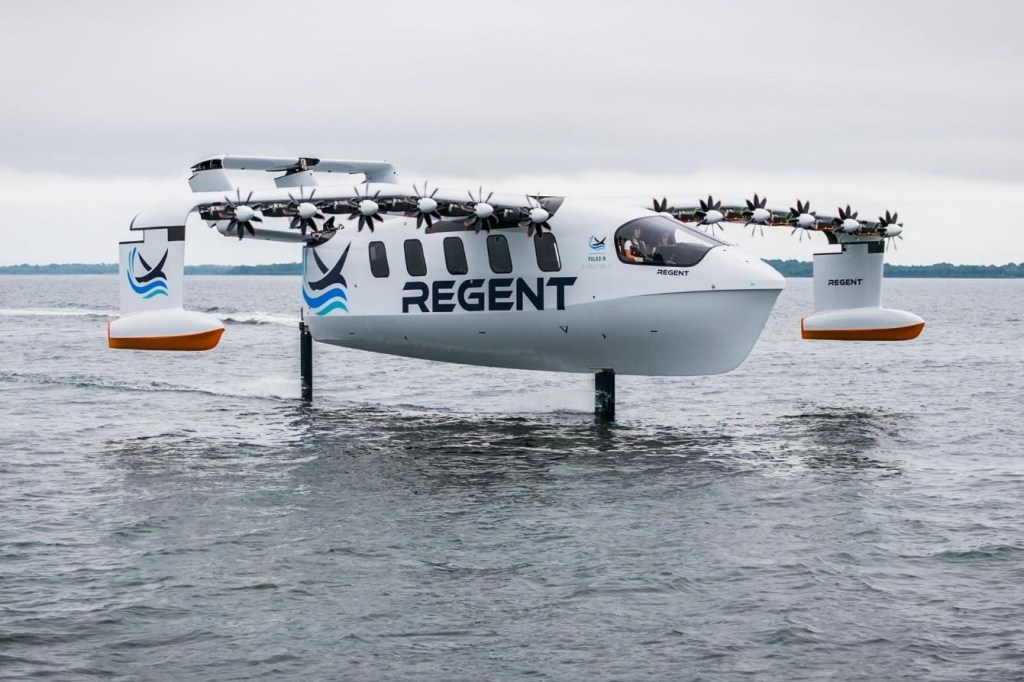
Image Credit: regentcraft.com
REGENT Craft, a U.S.-based startup founded in 2020 by aerospace engineers Billy Thalheimer and Mike Klinker, is transforming coastal transportation with its groundbreaking all electric seaglider technology. The company’s mission is to create a new category of maritime mobility that merges the speed of aviation with the accessibility of maritime infrastructure. At its core, REGENT addresses a growing global challenge: coastal regions and island communities around the world are underserved by existing transport options. Ferries are slow and often emit large amounts of CO₂, while regional flights are expensive and require extensive airport infrastructure. REGENT’s seaglider bridges this gap, providing a high speed, zero emission alternative that can operate directly from existing docks, harbors, and coastal facilities without the need for runways. The company describes its technology using the mantra “Float. Foil. Fly.”, a seamless operational model where the craft begins on water like a boat, rises onto hydrofoils for smooth transit, and ultimately glides over the ocean surface using wing-in-ground effect aerodynamics.
The company’s main portfolio product, the Viceroy Seaglider, is designed to carry up to 12 passengers or 3,500 lbs of cargo across coastal routes at speeds up to 180 mph (300 km/h) with a range of 180 miles (290 km) using current battery technology. Future variants, such as the Monarch Seaglider, will target 100 passenger configurations. The Viceroy operates through three key stages:
- Float Mode: The craft begins as a conventional boat, using its hull to float and taxi while departing docks or harbors.
- Foil Mode; Once the vessel reaches moderate speed, retractable hydrofoils deploy, lifting the hull above the water to minimize drag and wave impact, offering a stable, smooth ride.
- Flight Mode; At high speed, the seaglider transitions into ground effect flight, using its wings to generate lift while maintaining an altitude just a few meters above the surface. This allows it to achieve airplane-like speeds with a fraction of the energy.
This hybrid operational method is a direct application of wing in ground effect (WIG) physics, a proven aerodynamic phenomenon in which wings traveling close to a fixed surface, such as water, gain extra lift and reduced drag. REGENT’s innovation lies in combining this aerodynamic principle with advanced hydrofoil stability systems and fully electric propulsion, creating the first commercially viable, high-speed, zero emission maritime craft of its kind.
The technology addresses the growing need for faster, cleaner, and more cost-effective regional connectivity between coastal cities and island communities, drastically cutting travel times while eliminating carbon emissions. With substantial backing from investors such as E14 Vc, Founders Fund, 8090 Industries, Japan Airlines Innovation Fund, Lockheed Martin, and a $300 million financing partnership with MONTE, REGENT has raised over $90 million in equity to scale its production capabilities. Its portfolio includes the Viceroy for passenger service and the Monarch for heavy cargo and defense applications, both designed to enhance maritime logistics and coastal mobility for commercial and military operators. The seaglider’s aerodynamic design allows smooth transitions between water and air operations, powered by fully electric propulsion systems that reduce operational costs and environmental footprint. Despite regulatory challenges and sensitivity to rough sea conditions, the benefits of speed, reduced emissions, and port compatibility, make it a powerful solution for sustainable maritime travel.
Successful prototype tests and partnerships with Lockheed Martin and Fairlead demonstrate the technology’s readiness for both civilian and defense use, supported by a growing backlog exceeding $8 billion in orders, totaling more than 500 units from global ferry and airline operators such as Mesa Air Group and Japan Airlines. REGENT’s integration of aviation level safety standards, advanced hydrodynamic stability, and renewable propulsion places it at the forefront of maritime innovation, setting a new benchmark for the future of high speed, zero emission marine mobility.
Additional case studies and real world applications reinforce the practicality of REGENT’s concept. In September 2022, REGENT conducted the world’s first successful all electric seaglider flight in Narragansett Bay, demonstrating all three operational phases. In October 2023, the company signed a US$4.75 million agreement with the U.S. Marine Corps Warfighting Lab to test seagliders for littoral (coastal) logistics, highlighting defense sector confidence in the technology. A joint venture in the United Arab Emirates is also underway to manufacture and deploy seagliders in the Middle East, demonstrating the technology’s global scalability.
REGENT’s innovation is not only technological and environmental but also economic as the seagliders can operate at a relatively low cost: Electric propulsion and the use of existing port infrastructure reduce both fuel and maintenance expenses. In addition, it aims to increase safety and comfort through its Hydrofoil-assisted flight that minimizes the effects of waves and turbulence, ensuring stability even in moderate sea states. Another advantage is its dual use flexibility, Seagliders are applicable for civilian and defense missions, including passenger transport, logistics, medical evacuation, and reconnaissance.
Final Thought
REGENT Craft stands at the forefront of a new era in maritime transportation. Its all-electric seagliders promise to redefine the way people and cargo move across the sea, combining sustainability, speed, and affordability in one unified platform. While challenges in regulation and infrastructure remain, the company’s strong investment base, advanced engineering, and growing list of partners and clients position REGENT as a pivotal player in the global transition toward clean, high speed maritime mobility. For seafarers, coastal communities, and international logistics networks alike, REGENT’s vision offers a glimpse into a future where the ocean becomes not a barrier, but a highway of sustainable connection.
References
REGENT Craft. (2022, September 15). REGENT Completes World’s First All-Electric Seaglider Flight Unlocking a New Era of Maritime Mobility. Retrieved from https://www.regentcraft.com/news/regent-completes-worlds-first-all-electric-seaglider-flight-unlocking-a-new-era-of-maritime-mobility
REGENT Craft. (2023, October 5). REGENT Raises US$60M Series A to Define New Era of Sustainable Transportation. GlobeNewswire. Retrieved from https://www.globenewswire.com/news-release/2023/10/05/2755328/0/en/REGENT-Raises-60M-Series-A-to-Define-New-Era-of-Sustainable-Transportation.html
REGENT Craft. (2025, May 18). REGENT and Fairlead Partner to Accelerate Seaglider Vessel Deployment and Advanced U.S. Maritime Capabilities. Retrieved from https://www.regentcraft.com/news/regent-and-fairlead-partner-to-accelerate-seaglider-vessel-deployment-and-advanced-u-s-maritime-capabilities
Schwaabe, D. (2025, September 30). The Dawn of the Seaglider. Maritime Innovation & Electric Mobility. Retrieved from https://maritime-innovations.com/regent-electric-seaglider-2025 TechCrunch. (2023, October 6). Electric Seaglider Startup REGENT Takes Flight with $60M in New Funding. Retrieved from https://techcrunch.com/2023/10/06/electric-seaglider-startup-regent-takes-flight-with-60m-in-new-funding/
 Scorpa's Tech @ Sea
Leave a comment