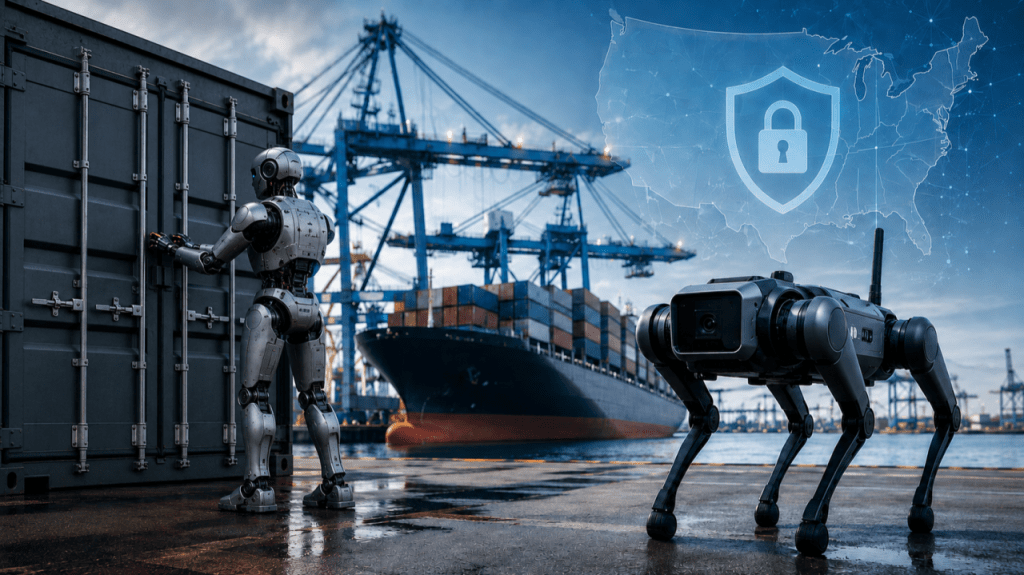
US ports are experienced dealing with the impact of import restrictions but the challenges they face are no longer restricted to monitoring goods passing through their terminals. Increasingly, the equipment they use to modernize their operations is also under scrutiny; US ports spent the last two years navigating security advisories on Chinese built cranes. The next chapter will focus on supply chains of next gen robots.
On 28 July, the FCC added “advanced robotic devices”, which include humanoids and quadrupeds, to its Covered List. New foreign-produced models can no longer get the equipment authorisation needed to import, market or sell them in the US. The national security determination is blunt: these devices collect data that could be used to surveil, and could be remotely commandeered. Essentially, a quadruped is a networked sensor with legs that can be hacked, either by force or by design.
While the announcement was careful to specify foreign-produced models, given geopolitical tensions, it’s reasonable to assume the FCC was targeting Chinese manufacturers. Early reports also suggest that the FCC is likely to exempt non-Chinese suppliers as it has already done with drones and routers. Companies like China’s Unitree, a global leader in humanoid robots, are expected to be hit hardest. Read this as what it is: the low-cost tier just left the US market. Chinese quadrupeds start under $3,000. A Boston Dynamics Spot is reportedly around $75,000.
The fortunate part is that most port robotics work is still at pilot and evaluation stage. Nothing to rip out. The awkward part is what happens next. Rotterdam, Ningbo and Singapore can still buy the cheap tier and run twenty pilots to find the three that work. A US terminal now runs two and hopes it picked right.
That is a defensible trade. Nobody wants a commandeered robot inside the fence line. But it is a trade, and it will show up as a capability gap long before it shows up as a security incident. The need for low cost alternatives with equivalent capabilities is now critical if US Ports wants to stay competitive.
#Maritime #Shipping #PortSecurity #MaritimeCyber #Robotics


Leave a comment