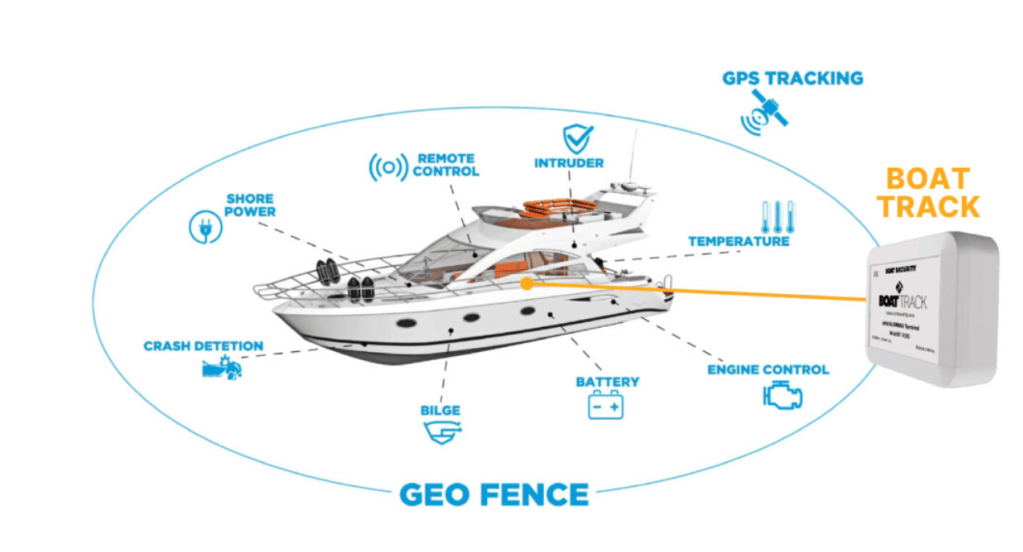
Source : https://boatsecurity.com/en/boat-track/
Background: The Blind Spots of the Blue Economy
The yacht charter industry is inherently fragmented, burdened by immense capital expenditures and acute operational risks. Fleet managers and private boat owners routinely lose visibility of their assets the moment they clear the harbor. Legacy tracking systems in this space have historically faced a compounding trio of failure points: high power consumption that drains boat batteries, patchy cellular-only coverage that drops off past the coast, and highly complex installation requirements.
When a chartered vessel sustains hull damage or encounters severe weather, the ensuing logistical chaos often triggers fierce liability disputes over speed, depth, and weather conditions. Openichnos emerged to exploit this structural vulnerability, positioning itself as an all-in-one remedy designed to streamline check-in/check-out procedures, settle damage disputes instantly through immutable data, and actively mitigate off-grid operational risks.
Openichnos has expanded its services to include real-time telemetry, geofencing, SOS emergency alerts, route history storage, weather monitoring, and smart fleet management analytics.
Openichnos was founded by George Koutras, a Greek technology entrepreneur and ICT specialist with more than 10 years of experience in information and communication technology (ICT) project management, software engineering, and maritime innovation. According to company sources, Koutras has worked on several European and Greek-funded research projects and has extensive expertise in cloud systems, IoT technologies, and digital transformation solutions for the maritime sector.
Founder Story: From ICT Architecture to High Seas IoT
The operational blueprint of Openichnos is heavily tied to the technical background of its founder and CEO, George Koutras. Backed by more than a decade of deep expertise in Information and Communications Technology (ICT) project management, Koutras refined his capabilities navigating complex software architectures across Greek research institutes and corporate software firms.
Prior to building Openichnos, Koutras was already an established entrepreneur within the ICT small-and-medium enterprise (SME) ecosystem. Recognizing that maritime tracking required a rigorous blend of hardware durability and cloud scalability rather than just generic consumer GPS pieces, Koutras forged a strategic synergy with OpenIT, a specialized software house. This operational partnership bridged the gap between raw hardware manufacturing and seamless cloud execution, allowing the startup to navigate early-stage product scoping without losing architectural agility.
Core Technologies: The Architecture of Pure Autonomy
Openichnos’s market differentiation relies entirely on its proprietary, plug-and-play tracking device engineered and assembled 100% within the European Union. The technology abstracts away the friction of traditional marine installations through a highly optimized, dual-layer hardware and software framework:
- 100% Energy Autonomy: Unlike competing hardware that draws directly from the vessel’s volatile electrical grid, Openichnos utilizes an independent, highly efficient power-management loop. Equipped with a proprietary non-toxic battery and integrated solar panel, the hardware can sustain continuous tracking operations for up to 60 days in absolute darkness and fully recharge itself with just two days of optimal sunlight.
- Hybrid Communication Switch: To achieve uncompromising global tracking coverage, the device embeds a smart hybrid gateway that seamlessly switches between cellular GSM networks and specialized satellite constellations. The system continuously polls locations using multi-constellation satellite tracking (GPS, GALILEO, and GLONASS), ensuring an uninterrupted stream of data regardless of distance from shore.
- The Connected Dashboard Ecosystem: The hardware translates raw marine telemetry into an intuitive cloud-based control center. Fleet managers receive instant, automated alerts via SMS and email regarding geofencing breaches, emergency SOS triggers, and engine maintenance alerts. Crucially for fleet liability protection, the platform indefinitely stores historical route data, pinning exact metrics on vessel speed, wind conditions, and localized nautical map depth.
Funding: Backed by Metavallon VC and Strategic European Capital
Navigating the hardware-heavy tech landscape requires a highly calculated approach to capitalization. Openichnos has successfully combined institutional venture capital with robust European SME support mechanisms to finance its scaling without falling into predatory dilution cycles.
A critical milestone in the company’s financial backing came from Metavallon VC, a prominent early-stage venture capital firm that focuses on high-potential technology startups coming out of Greece and Southern Europe. This institutional backing provided Openichnos with the necessary runway to bridge the gap between initial hardware prototyping and full-scale commercial manufacturing.
Furthermore, the company formalized its position in the broader European innovation network by registering with the EU Transparency Register, engaging directly with key policy initiatives targeting scale-ups and high-potential research ecosystems under the European Commission. This lean, strategic capitalization is sustained on the revenue side by a rolling, deposit-based monthly subscription framework, where fleet operators have the flexibility to pause plans during winter off-season, removing onboarding friction.
Final Thought
Openichnos’s strategic value lies not merely in tracking boats, but in standardizing risk metrics for the maritime insurance and charter ecosystems. By capturing granular, historical telemetry data such as exact depth metrics and wind conditions throughout a voyage the platform effectively strips out the costly guesswork from damage and insurance claims.
As the leisure maritime market expands under the pressure of rising operational costs, fleet owners can no longer afford to operate with blind spots. By solving the three fundamental barriers to maritime IoT deployment power dependency, connectivity drops, and installation complexity, Openichnos is transforming from a regional tracking tool into an indispensable piece of digital infrastructure for the modern connected yacht.




Leave a Reply