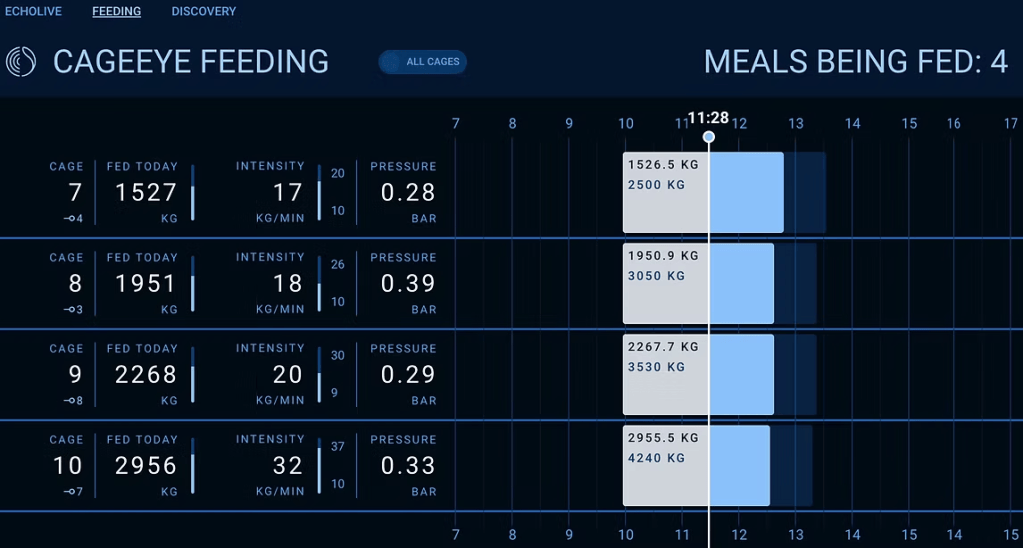
Image Source: cageeye.com
The global salmon farming industry is fighting a multibillion-dollar battle against an invisible enemy: deep-water biological hazards. In the high-energy marine environments of open-sea cages, farm operators have long flown blind, relying on surface cameras and manual observation to manage feeding schedules. This optical limitation triggers a brutal economic toll in which feed wastage accounts for up to 20% of total production costs, while excess nutrient discharge from uneaten pellets severely pollutes local marine ecosystems.
CageEye, a Norwegian precision aquatech pioneer operating under its parent brand Bluegrove, is structurally engineering a solution by replacing light with sound. Utilizing upward-facing, hydroacoustic echosounders coupled with advanced data processing, the Oslo-headquartered firm provides a non-intrusive window into deep-water pens. The technology translates acoustic backscatter from fish swim bladders into real-time behavioral data, effectively removing the human guesswork from industrial feeding loops.
Background: The Failure of Optical Logistics
The core maritime challenge of aquaculture stems from water column turbidity. When storms hit or algae blooms surge, standard visual sensors fail. This forces farm technicians to manually guess fish appetite levels resulting in either underfeeding, which stunts biomass growth, or overfeeding, which degrades the seabed with wasted resources.
CageEye’s hydroacoustic architecture bypasses surface constraints entirely. By deploying sonar sensors that analyze 100% of the fish with representative coverage, the system maps the vertical movement patterns of the entire biomass 24 hours a day, establishing a continuous, automated feedback loop that functions independent of water visibility, turbidity, or sunlight conditions.
Founder Story: From Academic Research to Industrial Scale
The commercialization of CageEye’s underlying software is rooted in years of rigorous hardware iterations and extensive R&D in Norway. The company’s technology traces its roots back to pioneering academic research, with Bendik S. Søvegjarto serving as a primary driving force and CEO during its major scaling phase. The foundational hydroacoustic processing software used to track individual and schooling fish was originally developed by Helge Balk, a researcher at the University of Oslo.
In 2020, to accelerate the vision of a comprehensive “Internet of Species” platform, CageEye executed a strategic cross-sector merger with Sealab and Blue Ocean Technology to form Bluegrove. This consolidation successfully bridged deep behavioral analytics with industrial sensor hardware under a single corporate umbrella.
Core of Technology: Hydroacoustic Intelligence Meets Pellet Detection
The operational mechanics of CageEye rely on a simple biological rule of thumb: hungry fish migrate vertically toward the surface, while satiated fish dive deeper into the water column. The company commercializes this through its core platforms: CageEye Feeding and Discovery. Utilizing its own custom-developed sensor arrays and a proprietary cage cabinet, the system processes acoustic signals directly on the cage 24/7.
The upward-looking echosounders continuously track fish positioning and behavior. In a recent development, CageEye has upgraded its ecosystem by combining this hydroacoustic framework with advanced Pellet Detection. While machine learning algorithms filter out environmental noise (such as boat engines and air bubbles) to assess fish appetite, the pellet detection layer tracks unconsumed feed drifting down the pen. This allows the automated system to instantly halt or accelerate mechanical feed spreaders, maximizing feed efficiency and fish welfare simultaneously.
Funding: Financing the Digital Blue Frontier
Transitioning CageEye from an academic research project into an international commercial standard required a substantial influx of global sustainability and tech capital. The firm’s institutional funding journey began with an early-stage IoT-focused seed round from Breed Reply in June 2018.
The trajectory rapidly accelerated in October 2018, when CageEye secured a €5.3 million to €6 million Series A round led by sustainable aquaculture investment heavyweight Aqua-Spark. In October 2021, the firm captured a €3.5 million package consisting of equity and grants from the European Innovation Council (EIC). This was followed in January 2022 by a €12 million equity refinance from existing shareholders to solidify the Bluegrove merger ecosystem. Long-term scaling has since been anchored under the Blue Revolution Fund, managed by Hatch Blue and The Nature Conservancy.
Final Thought
Bluegrove’s CageEye represents a profound evolution from reactive, camera-reliant observation toward autonomous biological tracking. By securing high-quality impact capital and validating its yield improvements with major market collaborators like Cermaq, Lerøy, NovaSea, and Salmones Aysén, the firm has established a highly defensible moat in the expanding blue economy.
References (APA Style)
Christiansen, S., Titelman, J., & Kaartvedt, S. (2019). Nighttime swimming behavior of a mesopelagic fish. Frontiers in Marine Science, 6. https://doi.org/10.3389/fmars.2019.00787
Måløy, H. (2020). EchoBERT: A transformer-based approach for behavior detection in echograms. IEEE Access, 8, 218372–218385. https://doi.org/10.1109/access.2020.3042337
O’Donncha, F., Stockwell, C. L., Planellas, S. R., Micallef, G., Palmes, P., Webb, C., Filgueira, R., & Grant, J. (2021). Data driven insight into fish behaviour and their use for precision aquaculture. Frontiers in Animal Science, 2. https://doi.org/10.3389/fanim.2021.695054
Schmidt, M. B., Tuhtan, J. A., & Schletterer, M. (2018). Hydroacoustic and pressure turbulence analysis for the assessment of fish presence and behavior upstream of a vertical trash rack at a run-of-river hydropower plant. Applied Sciences, 8(10), 1723. https://doi.org/10.3390/app8101723
Tušer, M., Brabec, M., Balk, H., Draštík, V., Kubečka, J., & Frouzová, J. (2023). Feasibility of time-dependent amplitude in pulse-compressed broadband acoustic signals for determining the dorsal orientation of fish. Water, 15(8), 1596. https://doi.org/10.3390/w15081596


Leave a Reply