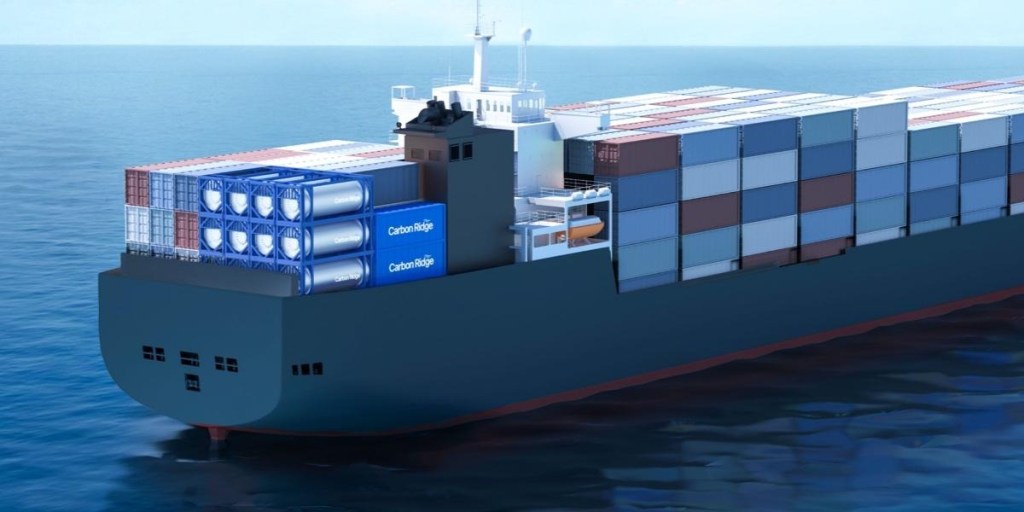
For the global shipping industry, the “green” transition has often felt like waiting for a ghost ship. While the world’s merchant fleet is responsible for nearly 3% of global greenhouse gas emissions, the promised era of hydrogen or ammonia-powered vessels remains decades away due to infrastructure and cost hurdles. Carbon Ridge, a California-based cleantech startup, isn’t interested in waiting. Instead, it is betting that the most efficient way to decarbonize the high seas is to capture the smoke before it ever leaves the stack.
The company is tackling a brutal engineering constraint: space. Traditional carbon capture systems are massive, land-based behemoths designed for sprawling power plants. For a shipowner, every square meter taken up by machinery is a square meter that isn’t carrying profitable cargo. Carbon Ridge’s breakthrough is a modular, centrifugal Onboard Carbon Capture & Storage (OCCS) system that is up to 75% smaller than conventional equipment. By using high-speed rotation to separate CO₂ from exhaust, the firm has turned an industrial process into a compact “plug-and-play” solution that fits onto existing vessels without requiring a total propulsion redesign.
The startup’s pragmatism has attracted a sophisticated roster of climate and maritime investors. Led by CEO and founder Chase Dwyer, a climate tech veteran, and co-founder Jim McDermott, Carbon Ridge recently closed a $9.5 million funding round, bringing its total capital to approximately $15.5 million. The cap table is a “who’s who” of maritime stakeholders, including Berge Bulk and Crowley, alongside heavy-hitting financiers like Crosscut Ventures, Western Technology Investment, and the Grantham Foundation. This backing suggests that shipowners are looking for immediate, retrofit-ready solutions to satisfy the International Maritime Organization’s (IMO) increasingly aggressive carbon intensity mandates.
The impact of the technology extends beyond just carbon accounting. Carbon Ridge claims its system can capture over 90% of CO₂ emissions while simultaneously scrubbing 99% of particulate matter and harmful pollutants like NOx and SOx. Because the system is fuel-agnostic, it serves as a “bridge technology,” allowing the current fleet of diesel-burning ships to remain compliant and operational as the industry slowly transitions to a zero-carbon future.
Final Thought: The Pragmatic Turn in Shipping
As 2026 unfolds, Carbon Ridge represents a shift in environmental strategy: moving from idealistic overhaul to industrial adaptation. The maritime industry cannot afford to scrap its entire multi-trillion dollar fleet to wait for “perfect” fuels. By shrinking the laboratory to fit the engine room, Carbon Ridge is proving that carbon capture isn’t just a terrestrial luxury, it’s a maritime necessity. In the race to net-zero, the winners won’t just be the ones with the cleanest fuel, but the ones with the smartest filters.
References
Carbon Ridge. (2025). Carbon Ridge scales modular OCCS technology with $15.5M in total funding. https://www.carbonridge.net/news
Crosscut Ventures. (2024). Investing in the blue economy: Why we led Carbon Ridge’s latest round. https://www.crosscut.vc/blog
Grantham Foundation. (2023). Decarbonizing hard-to-abate sectors: The case for onboard carbon capture. https://www.granthamfoundation.org/news
International Maritime Organization. (2023). Initial IMO Strategy on reduction of GHG emissions from ships. https://www.imo.org
Katapult Ocean. (2024). Portfolio spotlight: Carbon Ridge’s centrifugal capture breakthrough. https://katapult.vc/ocean
Contributor : Dyah Ayuning Tyas
Reviewer : Imam Buchari
 Scorpa's Tech @ Sea
Leave a comment