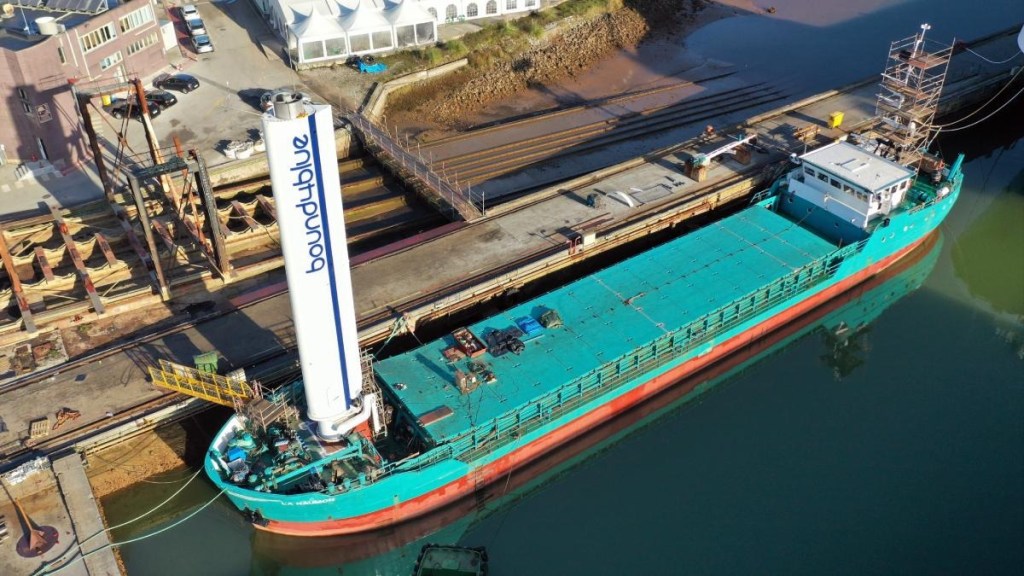
Image source: rivieramm.com
As the global shipping industry grapples with a tightening noose of environmental regulations and volatile fuel markets, a century-old solution is making a high-tech comeback. Bound4blue, a Spanish maritime innovator, is at the forefront of the “wind renaissance,” transforming massive cargo vessels into modern sailing ships to slash emissions and bypass the spiraling costs of traditional bunkers.
The maritime sector currently accounts for nearly 3% of global greenhouse gas emissions. For shipowners, the pressure is no longer just ethical, it is existential. New mandates from the International Maritime Organization (IMO), including the Carbon Intensity Indicator (CII) and the upcoming FuelEU Maritime framework, are turning inefficient ships into financial liabilities. “The industry is facing a pincer movement of regulatory penalties and fuel price volatility,” notes one market analyst. Bound4blue’s answer is the eSAIL®, a vertical, suction-based wing that uses aerodynamic lift to pull ships across the ocean, reducing the load on main engines and cutting fuel consumption by double digits.
The company’s trajectory has caught the eye of heavy-hitting institutional and strategic investors. Following a €22.4 million Series A in 2023 led by GTT Strategic Ventures and the European Innovation Council, bound4blue recently accelerated its scaling with a $44 million growth round in 2025. Led by OCTAVE Capital and Katapult Ocean, the fresh capital is being deployed to move the technology from bespoke pilots to industrial-scale fleet retrofits. With backing from the Louis Dreyfus Company and the Odfjell family office, the firm has successfully pivoted from a bold engineering concept to a commercially “bankable” decarbonization tool.
Technically, the eSAIL® represents a leap in automation. Unlike the canvas sails of the past, these rigid wings are fully autonomous, integrating with a ship’s bridge to adjust to wind conditions without crew intervention. The system’s versatility is its primary selling point; it is designed for both newbuilds and retrofits on tankers, bulk carriers, and Ro-Ro ships. High-profile partnerships with industry titans like Maersk Tankers and Eastern Pacific Shipping underscore a growing consensus: wind is no longer a fringe experiment.
Final Thought: The New Age of Sail
As we move into 2026, the maritime industry is reaching a tipping point where “wind-assisted” will soon become a standard line item in vessel specifications. Bound4blue isn’t just selling hardware; they are selling a hedge against a carbon-taxed future. While the total transition to green hydrogen or ammonia may be decades away due to infrastructure hurdles, the wind is free, ubiquitous, and available now. For a $14 trillion global trade network, the most advanced way forward may involve looking back to the horizon.
References
bound4blue. (2021). bound4blue raises €5 million to accelerate wind-assisted propulsion for commercial shipping. https://bound4blue.com
bound4blue. (2023). bound4blue raises €22.4 million to scale eSAIL® wind propulsion technology. https://bound4blue.com
bound4blue. (2024). bound4blue secures major wind propulsion retrofit contract with Maersk Tankers. https://bound4blue.com
DNV. (2023). Wind-assisted propulsion systems: Technology outlook and decarbonization potential. DNV Maritime.
European Commission. (2023). European Innovation Council support for clean maritime technologies. https://eic.ec.europa.eu
IMO. (2023). Reduction of GHG emissions from ships: CII and EEXI explained. International Maritime Organization. https://www.imo.org
Lloyd’s Register. (2023). Validation of wind propulsion performance methodologies for regulatory compliance. Lloyd’s Register Maritime Decarbonisation Hub.
Marine Business News. (2025). bound4blue completes eSAIL installation on commercial tanker. https://www.marinebusinessnews.com.au
Smith, T. W. P., Jalkanen, J. P., Anderson, B. A., Corbett, J. J., Faber, J., Hanayama, S., … Winebrake, J. J. (2015). Third IMO greenhouse gas study 2014. International Maritime Organization.
Tillig, F., Ringsberg, J. W., Mao, W., & Ramne, B. (2018). Analysis of wind-assisted ship propulsion using computational fluid dynamics. Ocean Engineering, 161, 1–15. https://doi.org/10.1016/j.oceaneng.2018.04.065
Traut, M., Gilbert, P., Walsh, C., Bows, A., Filippone, A., Stansby, P., & Wood, R. (2014). Propulsive power contribution of wind-assisted shipping. Energy Policy, 64, 173–187. https://doi.org/10.1016/j.enpol.2013.09.024
Bound4blue. (2025). Scaling wind-assisted propulsion: $44M growth funding announcement. https://www.bound4blue.com/news
European Innovation Council. (2023). EIC Fund investment in bound4blue: Decarbonizing the maritime industry. https://eic.ec.europa.eu/news
International Maritime Organization. (2023). 2023 IMO Strategy on reduction of GHG emissions from ships. https://www.imo.org/en/MediaCentre/HotTopics/Pages/Reducing-GHG-emissions-from-ships.aspx
Maersk Tankers. (2024). Maersk Tankers partners with bound4blue for eSAIL® installation on MR tankers. https://maersktankers.com/news
Riviera Maritime Media. (2024). Wind propulsion: The commercial reality of suction sails. https://www.rivieramm.com


Leave a comment