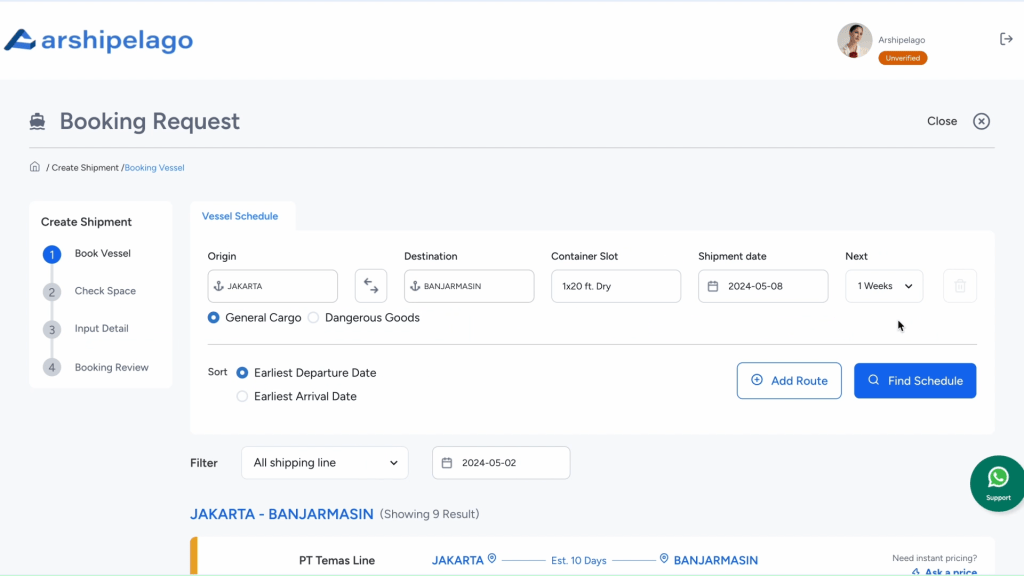
Image Credit: arshipelago.com
In Indonesia, the distance between ports is often measured not in nautical miles, but in the hours of frustrating phone calls and fragmented messaging required to move a single container. Despite its status as the world’s premier archipelagic nation, the country’s domestic shipping sector continues to present challenges for operators, where a lack of centralized data creates significant “hidden costs” compared to more integrated global markets.
Enter Arshipelago, a startup attempting to build the digital “operating system” for this fragmented maritime market. The company is targeting the information gap that has long hampered Small and Medium Business (SMB) freight forwarders, who struggle with volatile pricing and opaque vessel schedules across the sprawling chain of islands.
The Information Gap
“Ocean transport is the primary artery for Indonesian trade, yet it has been operating without a pulse-check,” the company’s leadership suggests. Historically, seafarers and logistics agents relied on manual coordination to secure space on container ships. This lack of visibility doesn’t just delay shipments; it throttles the growth of smaller players who cannot compete with the digital resources of global logistics giants.
The startup was co-founded by Achmad Feisal Anshari (CEO) and Sherwin Setiobudi (CFO), executives with deep roots in Southeast Asia’s technology and logistics sectors. Their premise is straightforward: by aggregating real-time data from diverse ocean carriers into a single cloud-based interface, they can bridge the digital divide that separates local ports from international shipping standards.
Capitalizing on “Logitech”
Investors are betting on this archipelagic math. Arshipelago secured initial funding and subsequently joined the Iterative Venture to accelerate its growth. While the company has kept specific valuation figures private to maintain a competitive advantage, the capital injection has been earmarked for a rapid scaling of its infrastructure and the expansion of its domestic route database.
The platform functions as a sophisticated aggregator, integrating with carrier APIs and verified data feeds to provide:
- Unified Booking: Instant visibility into schedules from major domestic carriers on a single screen.
- Dynamic Pricing: Quotations generated nearly instantly, replacing a process that previously took days.
- Fintech Integration: Short-term financing solutions to help forwarders manage the chronic cash-flow strain of upfront shipping costs.
Efficiency vs. Infrastructure
For clients like PT Amanah Trans Logistik and PT Samudera Pratama Artha Logistic, the shift has been tangible. By automating price discovery and documentation, these firms report they can now scale operations without the traditional overhead of adding more staff.
However, Arshipelago’s ambitions face structural hurdles: the uneven digitalization of the shipping lines themselves. The platform’s accuracy is often tethered to how well carriers update their own data. Furthermore, in remote ports where internet penetration remains a challenge, cloud-based precision must still contend with the realities of ground-level infrastructure gaps.
Final Thought: The Regional Ripple Effect
The success of Arshipelago may serve as a critical litmus test for “Logitech” in emerging markets. Beyond simply automating a booking process, the startup is attempting to formalize a shadow economy of maritime data. If they can successfully standardize the “information layer” of the world’s most complex maritime network, Arshipelago provides a blueprint for other archipelagic regions from the Philippines to the South Pacific looking to trade manual friction for digital flow. In the high-stakes game of global supply chains, the most valuable cargo isn’t just the goods in the container, but the data that tells you exactly when and how they will arrive.


Leave a comment