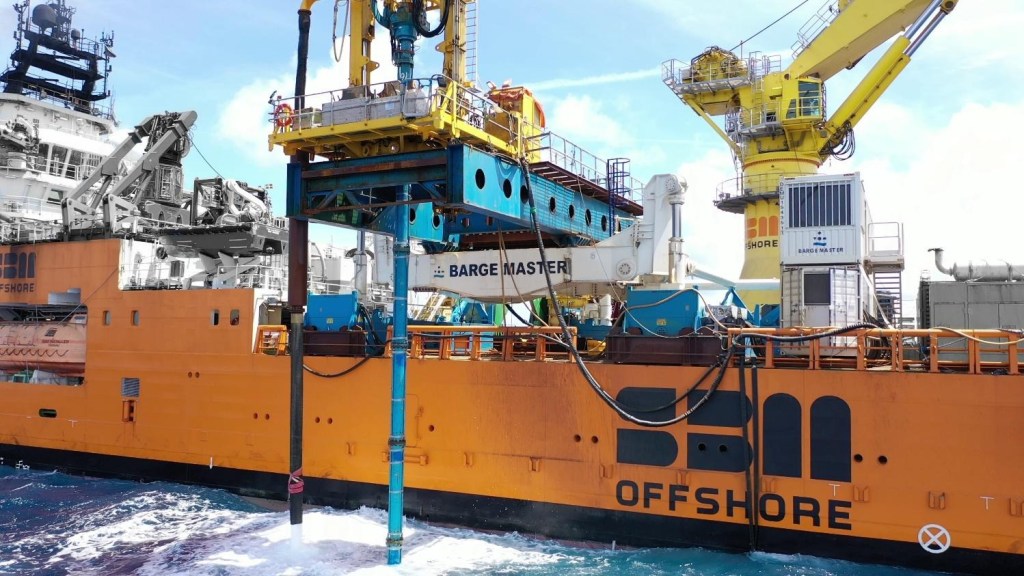
In the offshore world, the sea is the ultimate disruptor. Waves, currents, and wind induce movements that make heavy lifting and personnel transfer a high-stakes gamble. Barge Master, a Dutch leader in maritime innovation, is rewriting the rules of offshore work by developing active motion compensation technology that effectively “nullifies” the sea’s movement.
By transforming standard vessels into perfectly stable working platforms, Barge Master is bridging the gap between challenging sea states and operational excellence, ensuring that the most volatile environments on Earth remain productive.
Background: Improving Offshore Workability
Barge Master is dedicated to one mission: improving offshore workability. The company develops and provides motion compensation systems designed to stabilize load transfers and personnel movements, even in the most challenging environments like the North Sea.
Their technology acts as a “Sea Eraser,” decreasing dynamic loads and increasing safety. By providing a stabilized offshore environment, Barge Master allows operators to improve planning and cost efficiency, moving away from the expensive “waiting on weather” culture that has historically plagued the industry.
Founders & Leadership: A Vision for Stability
Barge Master emerged from the maritime hub of Rotterdam, led by a team of experts committed to solving the “unstable deck” problem. Today, the company is managed by Jan Dirk Hudig, Managing Director, alongside a team of engineers and maritime professionals who oversee everything from conceptual innovation to the actual utilization of systems in the field.
The leadership emphasizes operational excellence, ensuring that their systems ranging from motion-compensated cranes to feeder platforms are not just theoretical breakthroughs but proven tools with a global track record.
Case Study: The Vineyard Wind 1 Milestone
Barge Master’s impact is most visible in the surging offshore wind sector. A landmark case for the company is the Vineyard Wind 1 project, the first utility-scale offshore wind farm in the United States.
- The Operation: In partnership with maritime giants, Barge Master successfully executed the first feeder operation for the project.
- The Technology: The BM-Feeder and BM-T700 platform played pivotal roles, allowing massive turbine components to be transported and transferred from port to the installation vessel despite Atlantic swells.
- The Result: This operation proved that motion compensation is the key to scaling offshore wind in regions where traditional jack-up vessels are limited or unavailable.
Capital & Partners: A Strategic Asset in the InnovationQuarter Portfolio
Barge Master does not operate in isolation; its success is built on a high-tier network of industrial partners and strategic financial backing. A critical milestone in its growth was joining the InnovationQuarter portfolio. As the regional development agency for Zuid-Holland, InnovationQuarter has provided the strategic investment and network access necessary to scale Barge Master’s “Blue Economy” solutions.
In 2022, a multi-million euro investment round led by InnovationQuarter (via the Energy Transition Fund Rotterdam) helped accelerate the company’s expansion into the U.S. offshore wind market. This partnership embeds Barge Master into a world-class cluster of maritime companies, including collaborators like Shell, DEME, and GE, ensuring their motion-compensated solutions meet the highest global standards of safety and reliability.
Final Thought: Decoupling Work from the Weather
Barge Master represents a fundamental shift in how we interact with the ocean. By engineering a solution that “erases” wave motion, the company has decoupled offshore work from the volatility of the sea state.
As the world pivots toward offshore wind and more complex maritime infrastructure, the ability to stabilize the unstable is no longer a luxury, it is an operational necessity. Through the support of InnovationQuarter and a robust global partner network, Barge Master is providing the stillness required to power the 21st century.

 Scorpa's Tech @ Sea
Leave a comment