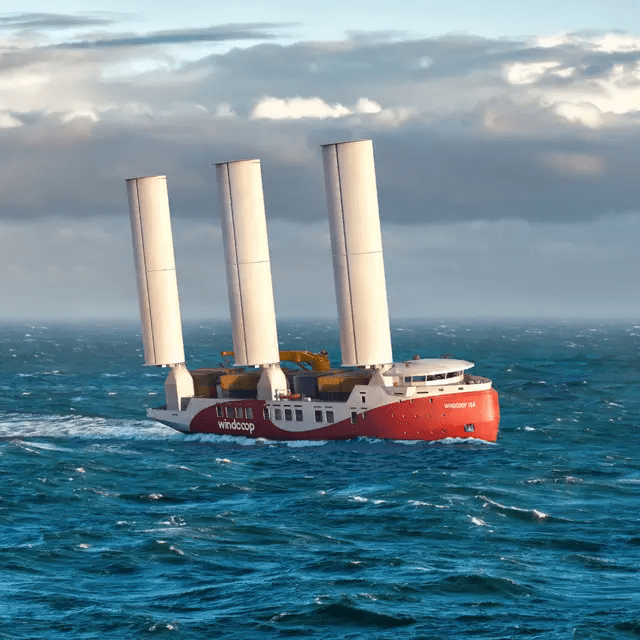
Source : https://www.wind.coop/
Windcoop is a French maritime cooperative transforming global shipping with wind-powered cargo vessels. It operates under a multi-stakeholder cooperative model (SCIC) to build and launch a wind-driven container ship. Through collective investment and democratic governance, Windcoop aims to offer a sustainable, low-carbon alternative to conventional fossil-fuel-intensive maritime transport, starting with a France-Madagascar route. Organized as a Société Coopérative d’Intérêt Collectif (SCIC), Windcoop invites individuals, companies, public bodies, and other stakeholders to become co-owners, influencing strategy and direction through democratic governance
Windcoop was founded by three individuals and organisations committed to a more sustainable future for maritime transport. The initiative was spearheaded by Matthieu Brunet, co-director of organic product importer Arcadie, who wanted to reduce the environmental impact of goods transport; Julien Noé, founder and chairman of Enercoop, a network of renewable energy cooperatives in France that brings a cooperative economic and ethical perspective; and Nils Joyeux, chairman of Zéphyr & Borée, a company specialising in low-energy ship design that also develops modern sailing ships. The three joined forces to establish Windcoop as a cooperative shipping company that combines ecological sustainability, transparency, and citizen participation in the future model of maritime transport.
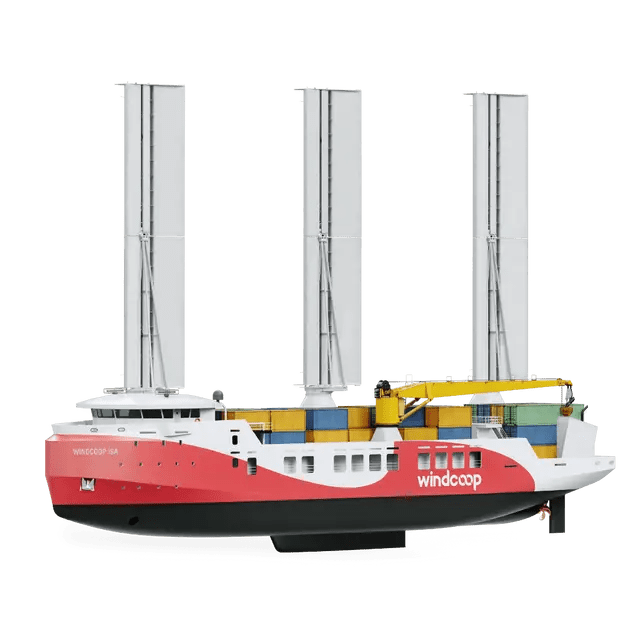
Source : https://www.wind.coop/le-voilier-cargo/
Windcoop’s core product is a wind-powered container ship designed to provide low-carbon maritime freight transport without sacrificing commercial viability. The vessel uses large rigid wingsails as its primary propulsion system, based on their website (wind.coop) It’s allowing it to harness wind energy to significantly reduce fuel consumption and greenhouse gas emissions by around 60% compared to conventional container ships. With a capacity of approximately 210 TEUs and the ability to carry refrigerated containers (reefers), the ship is suited for transporting food products, raw materials, and general cargo. An auxiliary low-emission engine is included to ensure safety and schedule reliability when wind conditions are insufficient. Beyond the physical ship, Windcoop’s product also includes a cooperative shipping service, where shippers, citizens, and institutions can become co-owners of the vessel, ensuring transparency, shared governance, and alignment between logistics performance and environmental responsibility.
Windcoop combines funding from various types of investors to realise its first wind-powered cargo ship. Its funding model is largely cooperative-based, with more than 1,600 individuals (civilians) and more than 1,800 ‘sociétaires’ (cooperative members) having purchased shares and contributed capital, thereby becoming co-owners of the cooperative and participating in the company’s strategic decisions. Funds from cooperative members amount to approximately €6.8 million, which are used for the initial payment of the ship’s construction. In addition, the project is also supported by banks and financial institutions through loans that cover most of the ship’s construction costs.
Other investors come from companies and professional organisations that are also potential customers for the ship. For example, importers and manufacturers such as Arcadie, Valrhona, Prova, Lobodis, Ethiquable, Cafés Richard, and Arawak are participating through cargo commitments and investments. In addition, there are institutional investors and impact funds such as La Banque Bleue, La Nef, Crédit Mutuel Arkéa, SIDI, Mer Invest, Inddigo, and Bretagne Capital Solidaire that support the project’s funding in the context of developing low-carbon maritime transport. This funding reflects a combination of support from citizens, ethically-oriented companies, and green/European investment institutions, which together are helping Windcoop realise its vision of sustainable shipping.
Final Thought
Windcoop represents a pioneering model at the intersection of sustainable innovation, cooperative economics, and maritime transport. By harnessing wind energy for cargo shipping and opening ownership to a broad community of stakeholders, it challenges traditional fossil-fuel-dependent logistics models. Through its cooperative structure, democratic governance, and committed funding base, Windcoop not only advances low-carbon transport solutions but also reimagines who can own and shape the future of global shipping. With the first vessel expected to enter service by 2027, Windcoop stands as a tangible example of citizen-driven ecological transition in a critical global industry.
References
Windcoop. (n.d.). Windcoop – Cooperative shipping powered by wind. https://www.wind.coop
Windcoop. (n.d.). Who we are. https://www.wind.coop/en/who-we-are/
Windcoop. (n.d.). Equity fundraising. https://www.wind.coop/en/equity-fundraising/
Maritime Executive. (2024). Construction order placed for world’s first sail-powered containership. https://www.maritime-executive.com/article/construction-order-placed-for-world-s-first-sail-powered-containership
PortNews. (2024). Windcoop secures €28.5 million for sail-powered container ship construction. https://en.portnews.ru/news/375513/
Assafina Online. (2024). Construction begins on the world’s first wind-powered container ship. https://assafinaonline.com/news_details/en/23652/Construction-Begins-on-the-World%27s-First-Wind-Powered-Containership
Hansa News. (2024). Windcoop orders container ship with sail propulsion. https://hansa.news/windcoop-orders-container-ship-with-sail-propulsion/
Contributor : Dyah Ayuning Tyas
Reviewer : Imam Buchari

 Scorpa's Tech @ Sea
Leave a comment